Showing posts with label Dr Who Suit. Show all posts

Thursday, July 31, 2014

San Diego Comic Con Masquerade 2014

So, ComicCon has come and gone, and we had a fabulous time! We did our skit for the masquerade. It was probably the biggest Masquerade event (in terms of audience-numbers) that I have entered. I was a bit nervous before going on stage, but I think that's understandable given the circumstances. Luckily, my butterflies were flying in formation, and it's not like I haven't competed in Masquerades before.

Our ring leader had us practicing our skit over and over. And once on stage, I was glad for all of the repeated takes. Our skit was very short (probably a minute at most), but I felt like we were going light-speed, but all of the practices had us (more or less) hitting our marks.

During the course of our rehearsals (of which there were many!), we talked about our expectations. We went into the masquerade for the sake of doing it. Because of the number of really good entries and costumers, we discussed that AT BEST, we might get "Audience Choice Award" or some such.

(There were 41 entries, but one scratched, so only 40 total).
Photo by Jean Martin ©2014

We had a mini-rehearsal that day @ 11am. Then we had to build our TARDIS, which was a PVC pipe framework. Our ring leader, who has a lot of experience in theatre, made the fame & covering. It was an ingenious piece of work, I tell ya. It was light enough to be carried by one person, but sturdy enough to withstand the stress we put it through.


At 5:00 pm, we had dress rehearsal with the full built TARDIS on the practice stage.

(Photo taken by Jean Martin. ©2014)

We had to get dressed and make-up done by 7:15 so as to take judges photos. And let me tell you, theatrical make-up is a pain to wear, but does help. The make-up artist who did my make-up was trying to give me as masculine features as necessary to play Tennant on stage (despite the big differences. Luckily, she knew a lot of drag queens. LOL.

My Viking had to do a double take, especially with the wig. (Theatrical makeup is not very attractive unless you're 10 feet away from me.)


The show started @ 8:30 pm - 11:00pm, but we had to wait around for judging (just in case). There were 40 official entries.  I think we finally managed to leave around 1:30 am, so it was a very long day.

Just before we went on stage, some of us said would be happy if we got a huge round of applause. And when we got on stage and the Doctor Who music started, there was a LOT of hooting & hollering. And when we filed out, one-by-one, the crowd went pretty wild, which made us SO DAMN HAPPY.

There were a total of 13 of us...12 Doctors and my Viking in the Tardis (who had the awesome idea on how to end our skit. Our presentation was called "Twelve", but our entry number was "17"......which caused a slight bit of confusion a bit later...)

So, imagine OUR surprise when they were making announcements backstage and our number was called to get back on stage! We were shocked! When they lined us up in order of awards, we thought we were going to get at least an "Honorable Mention" from where we were.

But then, one of the stage managers told us we had to move because there was a mixup (which sounded like a mixup due to the numbering confusion. She moved us to the back of the line....when the last of the final awards were called....the TOP AWARDS.

Myself and some others were literally bouncing up & down in excitement, because when we got on Stage, we were awarded with JUDGES CHOICE! (which is 2nd place, essentially).


We got enough medals for each of the couples that wanted one. Talk about rush! One of our doctors was in shock about the award and I had to ask her a couple of times if she was okay. I honestly thought she was going to either start crying or faint.

From the ComicCon 2014 Masquerade website:
http://www.comic-con.org/toucan/comic-con-masquerade-2014-winners
  • Judges’ Choice Twelve, Worn By:  The Time Lords; Designed and Made By: The Time Lords - 
  • Honorable Mention for Re-Creation Twelve, Worn By:  The Time Lords; Designed and Made By: The Time Lords

(This photo is from the SDCC newsletter. I'm trying to find more of all of us.)

It turns out that we had won two awards, but it made no sense for them to call us back up twice -- once for the "Honorable Mention for Recreation" and then again later for "Judges Choice". So, they just moved us to the more prestigious section of the line!

And here's a video from some friends who taped it for us!


The award really made the show for us and justified all of the hard work that each of us put into our costumes.

Wednesday, July 30, 2014

SDCC Masquerade Project #12 - The 10th Doctor Who Suit: Bonus Femme

I wonder if anyone noticed my numbering system for these super seekrit (not-so-seekrit) masquerade costuming blog posts (whew that was a mouthful).

If you did, then just know that I planned it that way, intentionally. And if you didn't, keep reading, and I'll explain it at the end.

For this very last post, I wanted to show you the last and final bonus piece I made for my 10th Doctor Suit. I wanted something a bit more femme, but still in keeping with the suit concept. There have been many Femme 10th Doctors (just do a search on 10th doctor femme) or check out this Tumblr.

I had enough fabric to do a waistcoat, and I had been saving all of my usable sized scraps for little things, like welts and the ilk.  I made the fronts & welts out of the fashion fabric and used lining fabric for the back and lining pieces.


Then it was a matter of adding buttons and viola! A waistcoat to add to a full three-piece suit Doctor Who ensemble! (I wore this outfit the day after the SDCC Masquerade along with a cross-play Rose Tyler, just to make things interesting.


Now, if you've read this far, and have not yet guessed the numbering system, well, there are 12 known doctors (not counting the War Doctor, which is not officially given a number). And currently, (at the time of this writing), not much is known about the 12th Doctor because the season hasn't started, so this post is really a short bonus posts.

So, in summation, there are TWELVE numbered posts (not counting the 1/2 posts scattered here and there). Plus, our SDCC skit was named "Twelve" (which is a happy coincidence_. Twelve posts for each of the 12 Doctors. And yes, I did actually plan it out that way

Tuesday, July 29, 2014

SDCC Masquerade Project #11 - The 10th Doctor Who Suit: Completed!

So, Comic Con has come and gone, and I'm sorely behind on photos & the rest of the making of this project. So, let's recap, shall we?

About 1.5 weeks before SDCC, I was 95% done with the suit. All I needed to do was hem the pants, and put buttons onto the jacket front & jacket sleeves.

However, I had a problem. I couldn't find proper suit buttons for the outfit for days. I looked at the local fabric stores and no one had suit buttons. There were a lot of brown "crafting" buttons (for children's button crafts) and a lot of fancy buttons, but no simple suit buttons.

I didn't have time to drive around and look for buttons, so I had to order them online and hoped they would get to me in time. They didn't. Since we were driving down to SDCC, I thought I could pick up some buttons in the LA Garment District and use those temporarily, until I got the proper suit buttons.

I did sew the buttons holes on the jacket (but didn't open them up) so that all that was left was to sew on buttons. 


Here's a photo of me in the nearly completed suit (sans buttons), and the David Tennant in his 10th Doctor Suit.


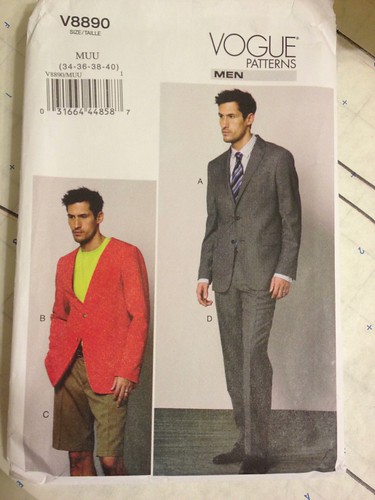
There are some differences, because I wasn't trying for a 100% perfect replica of the Tennat Suit, because there are major differences between our body types. I needed it to fit me well and look good enough on-stage and in-person to be recognizable as his suit.
  • Tennant has a long torso and long legs, whereas I do not (short waisted & short legs), so I had to make the jacket proportional to my dimensions, as well as all of the button placements
  • I also added side vents to the suit in addition to the back panel, because, well, I have hips and I need to be comfortable sitting & standing in the suit.
  • The fabric I used was fabric I had purchased for Joann's Fabrics over 5 years ago. It's not a complete match, but it's pretty damn close. It's 55% linen, 45 % rayon blend.  (The Tennant Suit was 100% cotton, which explains why he looked so rumpled all the time. Although, mind you, linen isn't that much better.)  Check out this link for a difference in the fabrics
  • I opted to do actual working sleeve buttons; Tennant's suit used faux sleeve cuffs -- in that the sleeve cuffs couldn't be opened up; the buttons were just sewn as "decoration". This makes sense from a theatrical standpoint, but I thought to diverge here.
  • I used a woman's cut pants pattern (see link here) because, well, I'm a girl, and I need them to fit properly.  Plus, because I was running out of fabric to properly do the waist band as on the suit, I made do with slightly skewed striping.
I spent an hour in the SDCC hotel sewing on buttons for the Masquerade, which I normally hate doing. Typically, I much prefer finishing a costume for an event BEFORE the event and not have to do any work during the event. But, sewing on buttons was a simple task (although I forgot to bring backing buttons with me.

By now, you've already guessed the outfit, so I'll be renaming all of the previous topics according to: SDCC Masquerade Project - The 10th Doctor Who Suit.
.
I'll have photos up from San Diego Comic Con as soon as I can!

Here are some of my resources for the making of my 10th Doctor Who (Tennant) suit.


Thursday, July 10, 2014

SDCC Masquerade Project #10.5 - The 10th Doctor Who Suit - Shirt

My cosplay character wears a blue button down shirt as part of his ensemble. While I was making the suit, I was not planning on making one myself, because I figured I'd be able to find one commercially available.

However, but after looking online at various stores, I started to get a bit concerned about being able to find a woman's button-down collared shirt made out of simple cotton. You would think this task would be easy, but it surprisingly was not.

I scoured online, especially shops catering to womens' business wear, like Anne Taylor, but did not find an appropriate shirt in the right color or style or material type. Apparently, women business shirts, tend to be white or pastel colors. And they also tend to be more of a "blouse" than a shirt --- blouses tend to be more loose fitting than a shirt.

When I did find a blue button-down shirt for women, they tended to be chambray instead of simple cotton (think more like a denim shirt.)

At one point, I was contemplating visiting a men's clothing store, like Men's Wearhouse, as a final resort. Men's business shirts tend to be a little bit more expensive (I was a bit shocked at the price of a decent business shirt), and they don't quite fit women correctly (given that women have boobs and hips). I was consigning myself  to pick up a small men's shirt and do some minor modifications to get it to fit correctly on me.

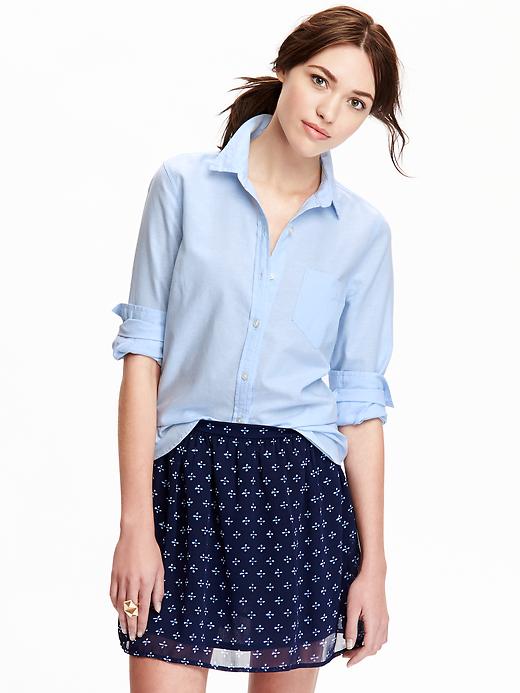
However, on a lark, I decided to look at non-conventional clothing stores that don't normally carry women's business attire, like Old Navy, and I found the right shirt! Old Navy had a women's "Oxford" shirt that seemed to fit my requirements.


Luckily, there's an Old Navy close to my house, so I was able to go there during the weekend along with the tie to get a color match.

The tie and shirt DID match, it was the right material (cotton), fit me relatively well, AND they were on sale, so SCORE on all counts.

Consequently, I picked up two of the same shirt, because you never know when one might get damaged, plus, they could be used for a number of purposes, including for actual work.


Now, I just have to finish up my suit!

Tuesday, July 8, 2014

SDCC Masquerade Project #10 - The 10th Doctor Who Suit - Inner Jacket Parts

With the pants complete, I got back to work on the jacket. It involved finishing seaming the sleeves (which had been basted to the jacket), add the shoulder pads, and then add the inner jacket facings and the lining.

My Viking made my shoulder pads for me. My right and left shoulders are slightly different in size, so I can't use commercially available shoulder pads. Luckily, they are relatively easy to make. He took some wool felt and shaped them, added padding, etc.,. We tried them out in the jacket shell and once he was happy with the look, I tailor stitched the pads using the sewing machine.


 Then it was a matter of shaping the shoulder pads slightly with a bit of heat, then sewing it into the shoulders. Luckily, wool felt is easily shape-able using a tailor's ham and a warm iron.
 Then it was a matter of hand-sewing the shoulder pads into place.


Once the shoulder pads were firmly in place, it was a matter of adding the facings & linings into the garment. Normally, for modern clothing, lining for clothes is bag-lined(link), however, I opted to do a more tailored techniques, which involved a lot of hand-sewing. And hand-sewing always take a lot longer to accomplish; partly because it involves a lot of futzing.


The inside of the jacket has two parts, the facing and the lining. Both line the inside of the jacket, but are made of different materials.
  • The facings are the inside of the jacket that can be seen, such as the turn of the collar. Consequently, they are made out of the same material as the fabric of the coat.
  • The lining of the jacket is what most people are familiar with, and is usually made out of lining fabric.

The jacket facings have an inner welt pocket, which needed to be made before it can be attached to the coat. I used scrap fabric to do the welts and lined them up as much as possible.


Then, the facing was sewn into the jacket, then the rest of the lining was attached by hand.


Handsewing the body lining was right-pain-in-the-arse, and it took several hours to complete, but the end result is looking pretty good.

Now, I just have to finish adding the sleeve lining.... (sigh). I hate sleeves.

Saturday, July 5, 2014

SDCC Masquerade Project #9.5 - The 10th Doctor Who Suit. It's a Tie!

One of the elements of the costume that the character wore is a tie, of which there are many, and that are carefully cataloged by another costumer.

From my readings of others experiences with making this outfit, I was lucky enough to find that a particular store in the UK, Debenhams, carries one of the ties (as described in this post).

It wasn't too expensive (compared to how much ties cost in the U.S) and shipping was very reasonable, especially coming from the UK. So I ordered it.


It's a rather pretty tie. Now, I just need to get a shirt that matches it.

Friday, July 4, 2014

SDCC Masquerade Project #9 - The 10th Doctor Who Suit.Whos' Got Pants?!

After making nearly all of the jacket, I could turn my attention to the necessary pants. I thought that I had enough to make the pants, but the question was...did I really have enough?

I laid out the fabric and the largest pattern pieces, and to my dismay, I didn't have quite enough fabric (width-wise) to cut out. Admittedly, I had a moment of panic, enough to say a few choice words unfit for children's ears.

(Note the overlapping pattern pieces)

However, I remembered that the pattern, itself, was pretty generous with how much extra they added for tailoring and fitting purposes. I had taken in the side seam and inseam by quite a bit, so I knew I could futz with how much of the pattern I could reasonably alter that would leave me about 1/2 inch of seam allowance. I could live with 1/2 inches of seam allowance as it would give me some room for any additional tweaks I needed to make.

I took a ruler to the pattern and drew out a few extra cutting lines at different amounts to shaving off some of the width (1/2 inch, 5/8inch, etc). Then I laid it out on the fabric again. It would be tight, but I managed to squeeze the entire width of the pants onto the remaining fabric.


Unfortunately, this meant that there could be no mistakes, and there would be no pattern matching for certain pieces, but at this point I didn't quite care as I was glad to have enough for what I needed, and maybe a little extra left over to make something small.

I did do some pattern matching for some of the more obvious pieces, like the pockets facings, but this pattern piece was relatively small, and I used some scraps left over from the jacket, so I could reuse as much as possible.


However, there were certain pieces, like the waistband facings and zipper facings, where I just didn't bother pattern matching.

The original costume has horizontal stripes for the waist band, but as this part is going to be covered by the jacket, I felt that it wasn't going to be completely necessary to have the stripes horizontal. Plus, as mentioned above...I didn't have enough fabric to make it completely accurate.

One of the back pant pieces.

Overall, the making of the pants went much quicker than the jacket itself. There were some fussy bits, like the zipper. Zippers are always a little bit tricky, but a good narrow zipper foot can be your best friend at times like these.

And there was some hand sewing that needed to be done in a few spots. I also realized that I had placed the zipper about 1/2 inches too far down (which I'll be modifying in the pattern notes later), but it isn't a show stopper.


But in the end, I had a working pair of pants that fit me very well. I just need to hem them now.


Now to actually finish the jacket....


Thursday, July 3, 2014

SDCC Masquerade Project #8 - The 10th Doctor Who Suit.Pants and Pants

I decided that I needed a break from working on the jacket sleeves, so I started the mockup for the pants. After consultation with my Viking, we decided to go with a Simplicity pattern, instead of the pants that came with the suit pattern.

Untitled

Why? Because I have hips and most men's tailoring doesn't account for the difference between a woman's hip & waist measurements. And I wanted something more fitted.

This particular pattern has three different options of a "Slim", "Average", and "Curvy" fit, and would, hopefully, require little tailoring.


I started making the "Average" fit, which fit pretty darn well, but I wasn't particularly happy with how it might look with the jacket, so I decided to also make the "Slim" fit and see if that made any difference. Plus, I have never really made tailored pants before -- having only made drawstring pants or wrap-arounds, so more practice was not unwelcome.

Consequently, I spent an entire weekend making two sets of pants of slightly different cut and ease. Overall, the pattern was pretty close to dead accurate. I was really pleased with it, although I did have to read certain steps of the instructions several times to understand what they wanted.

I did have to do some minor fitting -- mostly taking in the side seam and inseam by a good solid inch (4 cm), but I had to do little else. 


I tried both on and had my Viking give me his review. He and I really liked both pant patterns, but in the end, we decided to go with the "Slim" fit of the pants as they look better a bit more tailored and fit me slightly better with less ease.

The "Average" version fit more like chinos or cargo pants/shorts, while the "Slim" version fit more like suit pants.  I'm definitely using this pattern to make various pants of both varieties. After everything is said and done, I think I shall be making myself a pair of shorts from the "Average" version of the pattern.

Now, I just need to cut out the fashion fabric and sew up the pants!


And finally, the gratuitous kitten picture. Sammy could care less about my pants as he snoozes on his decoy fabric. 

Tuesday, July 1, 2014

SDCC Masquerade Project #7 - The 10th Doctor Who Suit. EEVIL SLEEVES

Sleeves are the bane of my costuming existence. I hate easing. I hates sleeves, yes I do. A friend of mine called them "sleevil", which is an appropriate term for them; sleeves + evil = sleevil.

There are many instructions on how to do set-in sleeves (for example, Craftsy has a photo tutorial), but regardless of who writes the instructions, the actual reality of setting in sleeves is much harder than what most of the deceptively easy instructions would have you believe, especially when there is a lot of extra fabric in the sleeve that needs to be eased into the body.

There are techniques & tips that make things "easier", such as ease stitching, a tailor's ham, and the copious use of pins. (There are "cheater" methods for setting in sleeves (like this one), which I've used for very simple garments, like shirts, but that don't work with highly tailored or more complicated garments, like the one I'm making.)

I tend to use a combination of all three of the above mentioned techniques to get a decent ease. First, I add 3 lines of ease stitching along the sleeve cap to start the easing process. Then I pin all the appropriate markings together to anchor the sleeve and set the endpoints for the easing.

I use a ham to help the easing process around the curves. Most people use a tailor's ham to press curved seams, but they are extremely helpful in easing too.  (You pin parts of the curved area to the ham, then start pinning fabric together)

Also, a ham holder made my life much easier when using a tailor's ham

I use a bajillion pins when easing the sleeves.


From personal experience, hand-basting sleeves is much more efficient than trying to machine baste, especially with so many pins sticking out of the sleeve. It's also easier to slightly shift the ease around with hand-basted stitches with your fingers. (Once you're happy with the handbasting and have removed the pins, you can machine stitch the armscye.)

However, despite all of these precautionary methods , I still find myself having to "redo" sleeves several times over because the sleeve is just not set-in correctly and there are obvious bumps, tucks, and wrinkles. And this costume was no exception. A one point during the construction of this jacket, I actually became extremely frustrated and turned to my Viking for help, since he's much better at setting in sleeves than I am.


We'll see how well I manage to ease in these sleevils.....

Sunday, June 29, 2014

SDCC Masquerade Project #6.5 - The 10th Doctor Who Suit - Shoe Score!

Today, I had to go over to Joann's fabric to pick up some fusible interfacing and a 7" inch zipper. There's a Kohl's nearby, so I stopped in on a whim. I knew that they carried the shoes I needed for my costume, and I wanted to see how much they cost.

As luck would have it, they were having a sale on the very shoes. And I had Kohl's cash (essentially you get cash back on a percentage of your previous purchases).

So, I managed to walk away with the shoes for my costume for $17.00 USD! (These are normally $55-59.00 USD.)


Now, I have sand shoes! Happy dance!

Friday, June 27, 2014

SDCC Masquerade Project #6 - The 10th Doctor Who Suit - Finishing the Body

After the front pattern pieces were finished -- adding all of the pockets, interfacing, and padding, it was time to cut out the side pieces and back pieces in order to match the stripes.

Luckily, the side and back pieces required less prepatory work than the front pieces, but it still required some work.

There are two side pieces (Left & Right) that were the easiest to assemble. Each side needed an interface piece, which was easily basted onto the fabric via machine.

The two back pieces (Left & Right) required slightly more work. I had modified the back pieces to include a back vent (per the actual costume worn by the actor).  The original Vogue pattern has side vents, which I debated on removing from the costume, but my Viking pointed out that I, as a woman, have hips, and therefore need a little bit more room than the average male around that area. Plus, keeping the side vents would allow for a little bit more of movement than just a back vent. So, after some consideration, I elected to keep both of vents.

I used some scrap paper to create a back vent for the jacket (which was subsequently just taped onto the original.)


The two back pieces were sewn together and another piece of horsehair canvas needed to be added to the assembled back piece. This piece came from the shoulder seam to just below my shoulder blades.

It was machine basted onto it along the edges, but it did require a minimal amount of padstitching around the neck edges (for about an inch) and around the armscye edges to help keep in place. (The original Vogue instructions don't actually tell you to do this part, but I know from past experience -- as well as double-checking myself on my tailoring books -- that this step helps makes the jacket lay better.)


Once everything was interlined and basted into place, I could start sewing the side/back pieces to the front to form the shell of the coat.

It pleases me to no end when stripes match up.


Here's the completed body (sans sleeves).


Now, onto the hard part...the sleeves....

Thursday, June 26, 2014

SDCC Masquerade Project #5.5 - The 10th Doctor Who Suit: Fabric and Lining

(This post was originally named "Super Seekrit Project" -- which really wasn't a secret, if you're even remotely a fan of this particular show, but for the SDCC Masquerade, I wanted to keep things under wrap as much as possible.)

Over the weekend, I hit up the fabric store as I wanted to get lining for my costume. We only have black lining fabric in the house, which works for about 80% of all of our costuming needs. However, 20% of the time (and this is one of those times) that black fabric is just not aesthetically pleasing to use.

So, I ran down to one of the big box stores with coupon in hand to pick up brown lining fabric (I brought a piece of scrap fashion fabric to match the brown of the costume). I wanted to get either a matching brown or a matching teal color (just as a contrast color). They didn't have the teal, but they had a corresponding brown. And it was 50% off the price. SCORE!

Plus, I had a coupon for 20% of my total purchase price, so even better. I only needed about 4 yards, but I bought the rest of the bolt (at 7 yards), because you never know when you're going to need extra fabric. And I went off my merrily little way.

Here's the fashion fabric, the horsehair canvas, and the lining.


My fashion fabric is from Joann's Fabrics more than 5 years ago. Here are the specs:
  • Fabric Type: 55% linen 45% Rayon
  • Fabric weight: Medium
  • Fabric Color: Chocolate Brown
  • Pinstripes: Turquoise
  • Pinstripe width (in threads & mm): 2 threads - 1mm
  • Pinstripe repeat: 14.5mm
The original fabric is thought to be a lightweight 100% cotton with corn blue pinstripes @ 5 threads - 1mm
and repeat of 11.5mm. You can find more information on this website about the comparison of different fabrics: http://tennantsuit.blogspot.com/2009/04/comparing-fabrics.html

So, it's not a bad match -- certainly not perfect, but darn close enough.

Wednesday, June 25, 2014

SDCC Masquerade Project #5 - The 10th Doctor Who Suit: Front Pockets & Tailoring

It took nearly a full day to finish the front pattern pieces, as they required the most preparatory work before adding the side pieces. The easy part was to add the simple single darts, but then I had to add all of the pockets, interfacing, etc. And there was a lot of handstitching that had to occur.

First, I worked on the faux pockets, including adding the facing for the pockets. You can see where I did some pattern matching on the inner pocket.


Then created the faux pocket flaps that covered the inner pocket matching (but I know that they are there!) The faux pockets had to be handstitched down in certain locations to keep it from flopping or gaping.


In addition to the faux pockets, the left side had a patch pocket with a box pleat. I tried to match the stripes as best as possible (despite the fact that there's a dart underneath the pocket, while adding the box pleat. There was a lot of pinning and re-pinning.


Once the patch pocket was added, it was matter of lining up stripes on the refashioned pocket flap. 


After the pockets were added, I hand-basted each of the pockets closed so that they wouldn't gape or distort the fronts while I was sewing the rest of the outfit. Then, I could start to add the interfacing and padding.

 For the interfacing, I used standard horsehair canvas (not really made out of horsehair). I prefer horsehair canvas versus fusible interfacing mostly because I tend to find fusible interfacing (while extremely convenient) sometimes makes fabric too stiff and doesn't lay naturally. (I have been told that there is fusible hymo, which I haven't tried yet, but I didn't have time to order some and try them out.)

First, I took the horsehair and quilt stitched the padding (just some wool felt) to it, then basted it to the front along the edges. The padding helps fill out certain "hollows" in the human body, such as the shoulder hollow, so that the jacket lies in a straight line from the shoulder down. Some people require more padding than others. I also cheated and machine quilted the padding to the interfacing, which is an acceptable way of doing it, but most bespoke tailors will hand stitch the padding.


However, I couldn't get away from hand-stitching. I had to padstitch the lapel area to the front fabric piece, which took several hours to complete as it requires carefully catching only one thread of the fashion fabric (so that it doesn't show) and stitch it to the interface. (And there was at least once where I had to rip out all of my work because I had placed the tailor padding in-between the horsehair and fabric and didn't notice...)

Afterwards, I added a twill tape along the lapel roll line after cutting along that faint blue line. I handstitched the twill to either side of the horsehair.


The twill tape acts as a hinge to help the collar fold over and lay correctly; otherwise the horsehair will try to "unfold" the lapel to an open position.

Only after completing all of these steps could I then cut out the side and back pieces.