Showing posts with label spindles. Show all posts

Thursday, May 20, 2010

One Turkish Spindle

I've had a hankering to actually *use* the Jenkins Turkish Spindle that I got over at Stitches West -- nevermind I have 3 spinning projects already going (1 on the wheel, 2 on spindles).

I had 2oz of corriedale roving from Spunky Eclectic that was sitting there waiting for me to use. So, last night, I grabbed the Turkish Spindle, opened up Respect the Spindle to the Turkish Spindle section, read up on how to wind onto the arms, how to do a half-hitch...and away I went.

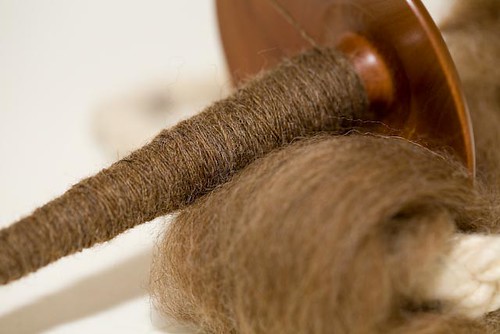
Eventually, I ended up with a bit of yarn.

Jenkins Spindle

Differences
I have to say that it was a lot easier than I had expected -- probably because I already have the basics done. But, having a bottom weight spindle was very different from my other top whorl ones. It's not better or worse, but just *different*.

* the whorl doesn't spin as fast as a top whorl spindle, but it does spin for a lot longer duration -- this takes some getting used to. As a result, the yarn is more loosely spun as woolen, versus worseted. Of course, I've also "dropped" the spindle several times because there wasn't enough twist (versus when I learned the top-whorl, where I had too must twist....)

* I have to make sure the bottom whorl doesn't actually bump into anything, like chair legs. The spacial requirements are slightly different.

* there's no hook, so I have to use a half-hitch at the top of the spindle, which is going to take a bit of practice.

* stopping & winding on the yarn isn't as 'easy' as a top whorl spindle, because I have to unhitch the half-hitch, then carefully wind onto the arms of the whorl.

Of course, I'm sure much of these differences are easily solvable by more practice and getting used to the differences. But other than that, I do like it. I think I might prefer my top whorl a teeny bit better, but again, it's just a different tool for the job.

Tuesday, April 6, 2010

Spinning a Japanese Maple

So, a while ago, I received this fiber & spindle from Butterfly Girl Designs:

Butterfly Girl Spindle & Japanese Maple roving
Japanese Maple - 70% merino, 20% bamboo, 10% nylon firestar


It reminded me of a Japanese Maple in the fall. Much like this:

(BTW, I love Japanese Maple Trees)

I used the pictured drop spindle to turn it into this:

Japanese Maple


And then, the poor fiber sat resting all this time, because I wasn't sure what to do with it! I wasn't 100% happy with how it turned out, because the colors (at least to me) seemed muddy, even though I loved the fiber colorway. I wanted more of the gold to pop.

However, I know that sometimes how the fiber looks prepared is a bit different from how it might spin up...or even how it might knit up. So, I wasn't ready to trash the project.

I debated plying it against itself or maybe spinning something to match or maybe a commercial yarn. In perusing through my stash, I remembered that I had this:

Jagger Main line Merino Gold
Jagger 100% Wool Cone -- 5000 yards


Certainly, I could spare a few hundred yards for this project? LOL. The coloration was close enough to the gold bamboo in the batt, so I opted to give it a go. So, I prepped up the Kiwi wheel for plying.

And at first, I wasn't too happy with how it looked, except for certain spots. But I opted to keep trying. I *knew* that the gold would bring out the colors and to trust myself on my knowledge of color theory. My plying wasn't the greatest, but a little help from Jasmin and I got this....


Japanese Maple

I am definitely in love. The gold really made all of the colors pop and tied everything together. I currently have 495 yards of laceweight/fingering weight yarn. Plus, I still have some of the batt left over. I think I might be able to squeeze another 50-60 yards out.

And think I've found the *perfect pattern* to go with the yarn. I'm not wholly sure how well this yarn will look in this pattern. So I will try a pattern swatch. Now, I just have to figure out how to knit up this pattern (coz after reading it, my head is spinning!)

Monday, March 22, 2010

The Art of Collecting Spindles

If you hit the Ravelry Spindlers Forum, Flickr Groups (such as SpindleShots), or whatnought, you'll notice that there are a LOT of spindle collectors out there.

It's much easier to collect spindles than it is to collect wheels (not to say that there aren't people who collect wheels!), but spindles take up considerably "less" space than several wheels. (Of course, if you have 100+ spindles, it might take up plenty of room!)

Of course, this is not a new phenomena. In Ancient Greece, spindles of gold & ivory were presented as gifts to women, and many have been found in the tombs of both men & women alike as burial items across various cultures. But, whether or not someone had dozens or even hundreds of spindles (if you weren't a professional spinner) is probably up for debate. I suspect that most ancient spinners might have had a small collection for utilitarian purposes, but not to the extent some spindlers have today!

Butterfly Girl Spindle & Japanese Maple roving
Resin Spindle


Spindle whorls have been created out of beads, shells, wood, ceramics, stones, bone, precious metals, semi-precious stones, and clay. Many are decorated with intricate carvings or ornate designs. And this doesn't include the modern day interpretations, such as resins, glass, and wood spindles with gold rims, etc! (I sometimes wonder what future archeologists & anthropologists will say when they uncover these tools and how they will compare it to *our* ancient forebearers.)

ZebIsis Design Spindl
Jasper Whorl Spindle


It seems to me that humans have been trying to spruce up their utilitarian tools to make them more pleasing to the eye when using them. I know I find an immense pleasure in just seeing my pretty spindles whorl in such a plethora of wide colors & patterns.

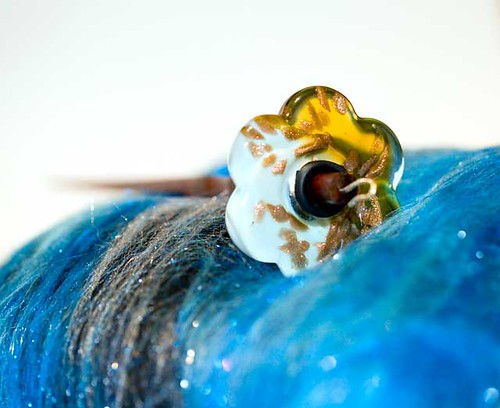
Butterfly Girl Murano Drop Spindle
Murano Glass Spindle


Insofar as myself, my collection isn't *that* big. I might have 7 spindles total, of varying materials and weights. But this doesn't mean I won't be acquiring more spindles in the near future.......

(And for now, I'm sticking with *one* wheel!)

Friday, March 12, 2010

Spindle Crush

I have a spindle crush. It's with the new Deborah Doyle spindle that I bought at Stitches West. It weights 1.25 oz, and is made of dark Cocobolo wood. And it spins like an absolute dream. The spin is so effortless, quiet, and just...amazing.

Deborah Doyle Spindle


I'm currently spinning about 2 oz of merino on this spindle, and every time I flick it, I'm absolutely delighted. I can't seem to stop spinning.

I think I might have a problem.....

Thursday, March 11, 2010

Spinner's Study: Alpaca & Merino

Alpaca

So, for Ravelympics, I was continuing my spinning study, on alpaca. Needless to say, I'm *STILL* working on finishing that 2 oz of alpaca. This is being spun on a Greensleeves 1.6 oz spindle. I'm not sure if what I have is suri or huacaya, but I had gotten it as part of my original box from Spunky Eclectic. It's a natural tan color.

Ravelympics Spinning


Notes:
- the alpaca is oh-so-buttery soft. It's very well prepared roving.
- the staple length is very *long* = 5-8"
- there's very little crimp in a given lock, so it's not very elastic.

I'm currently spinning it at about a heavy fingering or sport weight, as it seems to lend itself better to that weight. And I'm really really enjoying spinning this fiber.

However, I definitely would like to ply this with merino to give it a little bit of elasticity. I have some pure alpaca yarns, and while I love the drape and the feel, I think it would be better (for me) to mix this in with wool.

Merino
From my Spinner Study box, I have 2 oz of white merino, which is being spun on a Deborah Doyle (Asciano) spindle (1.25 oz).

Deboarah Doyle Spindle


Can I just say that I am *really* liking merino?

Notes:
- lots and lots of crimp, which means that it's.....
- very very elastic. There is definite "sproing" in the spun yarn. I can easily see this being over spun.
- I am currently spinning this at a fingering weight because I want to ply it with the above alpaca, but I can definitely see spinning this a lot thinner (laceweight) just because of the fiber properties.

Some personal notes:
While I like merino, I'm not sure if this will become my "Go-To" fiber (or Desert Island fiber). I find that I'm preferring a little bit of a longer staple length for spinning purposes. This isn't to say that I won't spin merino, but I can easily see this being blended with other fiber types (like alpaca) just to mix things around a little bit.

Monday, March 8, 2010

Review: Respect the Spindle

This past weekend, I finally picked up the book, "Respect the Spindle: Spin Infinite Yarns with One Amazing Tool", by Abby Franquemont, at a local bookstore.


Respect the Spindle


Can I just say this? WHERE was this book when I first started spinning on a spindle?!?! Oh yeah, she was just finishing up writing it and it was *just* about to be published. So, I didn't get the full benefit of it when I started spindling.

It came out about 3 months after I started spindle spinning. However, it's awesome book to read with a lot of information specific to spindle spinning that you don't necessarily get in other general spinning books (which mostly cater to wheel spinning). Despite it's focus on spindles, it's an overall good "spinning" book with information on drafting, woolen, and worsted spinning, plying (with some good photos on chain plying), etc. I've learned quite a bit more just by reading this book.

Abby does a really good job at breaking things down into easy-to-understand concepts about the hows and whys of spinning. Her writing flows nicely from one end of the book to the next. Her style is fluid and easy-to-read. She explains (with good photographs) the different spindle types, why they work, how they work, and what are the idiosyncracies between all of them. She goes over the physics of spinning, mathematics of spin rates, and a little bit about the history of spinning in general.

In addition to the above, there are some brief exercises for you to work on, how to determine your spinning rate, and then she also provides a few patterns for your first few skeins of handspun. She's very encouraging throughout the book, getting you to explore at your own pace, to find your own spinning "mojo", and to really understand that there is going to different ways of doing things.

(And there are also some very gorgeous photos of various spindles and fiber!)

Overall, it's a *wonderful* book. In terms of specific spindle books, I think this one sits at the top of my "recommended" list. It'll be the one I will be recommending to people who want to learn how to use a spindle. I know that I certainly learned a lot.

(As a side note: Books, such as The Bellweather's Productive Spindling (also a very good book) compliments Abby's book very well, going into some specifics (such as how to efficiently wind-on a cop for different reasons, etc).
I'll review the Product Spindling book at a later date.

Tuesday, March 2, 2010

Spreading the Evil

A few weeks ago, a good friend of mine (who beads) said she'd be interested in learning how to use a drop spindle. Her mother tried to teach her how to knit as a young girl & as an adult ...and each time it ended in frustrated tears...so she has no desire to learn knitting or crocheting. However, she *loves* fiber and thought that spinning might prove to be better for her, as she has watched me spin and loves the fibers that I make.

So, I got her a good inexpensive wood spindle from Stitches West (she was deathly afraid of dropping and breaking a spindle -- she saw my glass & resin spindles), and a pretty handpainted corriedale top. Plus I added "practice" fiber that I had left over from some dark BFL from my last spinning project.

Armed with Abby Franquemont's "Respect the Spindle" DVD and The Bellweather's book, "Productive Spindling", I went over and showed her the principles of parking & drafting, then left her alone while her hubby, DH, and I went off to dinner & a concert (as she was ill).

I came back with her spindle 1/2 full of what looked like a DK or worseted weight yarn. She said that she thinks she could really get into this, as it appeals to her Anal Retentiveness.....she can control every aspect of the twist (making her prefer worsted spinning over woolen).

So, I've done my part of spreading the evil....

Friday, November 13, 2009

A Backlog of Fiber

I have a backlog of fiber that I need to spin. I had bought a bunch of different 2oz samplers from Spunk Eclectic some time ago, and I've managed to get through only have of the different wool types I purchased!

I'm currently working on each one diligently (on the drop spindle) and taking notes on each one. I also bought a Phat Fiber Box sampler one month, as it was all *non* sheep wool fibers, and discovered that I don't actually like spinning pure silk, pure bamboo, seasilk, mulberry, or any of the "slick" fibers. (At least not yet).

AND, there's the spindle and fiber club from Butterfly Girl Designs, and I just got this lovely blend of fiber & spindle for the November club.

Butterfly Girl Murano Drop Spindle

AND I just recently acquired 8 oz (1/2 lb) of dark Blue Faced Leiscter, which is just so YUMMY which is getting spun on the Kiwi. I'd *like* to be able to have enough yarn to make a sweater, but in reality, I probably wont...but I'm hoping.

This doesn't count the Japanese Maple I'm still spinning on my Butterfly Girl resin spindle, OR the Shetland roving on my Kundert.

Have I mentioned that I knit too? and have several projects on the needles? OOF!

Tuesday, November 10, 2009

Spinner's Study: Shetland

As a mini-break from the Japanese Maple spinning, I opted to start spinning the lovely brown Shetland I had gotten from Spunky Eclectic

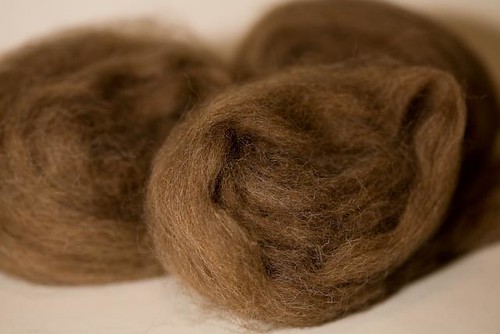
Shetland Roving

I had always thought that Shetland was a somewhat scratchy yarn with a high micron count, and I was expecting it to be about the same as the Icelandic wool that I had spun up, but OMG, this stuff is so much softer than Icelandic...almost as soft as merino....not quite, but it's a LOT softer than I was expecting.

I took a quick look online, and according to the Wild Fibres Website

Icelandic's micron count: 22-28 for the inner coat 55-65 outer.
Merino's micron count: 18-24
Shetland's micron count: 20-33

So, Shetland *can* be as soft as a decent merino. And the stuff I have is definitely falls in that range. (The merino I am comparing it too is definitely 'softer', but it's pretty darn close.)

Shetland on Drop Spindle

As I am still in the "Spinner Study" phase, I have no idea what this will make as of yet. I'm wondering if I should ply it with the merino or lighter brown alpaca that I have. So many decisions!

Sunday, November 8, 2009

Japanese Maple

I'm still plugging away on spinning the Japanese Maple colorway from Butterfly Girl Designs on the lovely resin spindle she had sent me.

Butterfly Girl Spindle & Japanese Maple roving

However, since the spindle is less than an ounce, it gets very wobbly quickly, so I have to wind off onto a bobbin so I can spin more (as I had gotten about 3.1 ounces). Consequently, I have about 2 full bobbins of the Japanese maple.

Japanese Maple

And I still have a lot left to go through. I figure I might be able to get another 1.5 bobbins out of the 3.1 oz of fiber. I'm still not sure if I'm going to keep this as a single or ply it.

I definitely want to make a shawl out of it -- probably a "flame" pattern shawl, because the colors of the fiber remind me a firey autumn.

Wednesday, November 4, 2009

Wheel versus Spindle

I have a tendency to spend a lot of time on the computer. We don't really watch t.v. so this is our substitute. However, usually, computer time involves some form of either work or play.

I've taken to keeping my drop spindle right by my computer. Anytime anything takes a bit of time to do (i.e. waiting for something to load up, or if I'm just reading an article online), I use the drop spindle. I have a knitting project usually by my computer, but the problem is that if there is a pattern of some sort, I have to pay attention to the knitting rather than what I'm doing on the computer. Sometimes this is not a good combination. However, I can put down my spinning at any given time and not have to worry about remembering where I left off.

This also means I get in a lot of little bits of time spinning in between projects. Now that I own a wheel, I realize that if I only had the wheel, I wouldn't get as much done. Don't get me wrong -- I *LIKE* the wheel. And, I'm getting a bunch of spinning practice done on it -- about 10-15 minutes a day. But, it sits in the living room isolated from most of the bustle of the household, which is nice when I want to get some alone time. It's a nice quiet form of meditation.

However, when I'm with DH or on the computer or on the go, it'll be the drop spindle I reach for the most -- it's very portable. And I know that plying will be more of a "breeze" on the wheel than on the spindle.

The wheel is going to get a lot of use; but I think the drop spindles are going to get much more used just because of my lifestyle.

Tuesday, October 27, 2009

Spindle Club & Spinning from the Fold

Back in late August, I joined the Butterfly Girl Spindle & Fiber club to get my fix of spindles. For September, she sent me this lovely black & gold resin spindle, along with some very tasty roving (a whole 3.1 oz) of the colorway Japanese Maple.

It was 70% merino, 20% bamboo, 10% firestar (angelina). The colors are just *GORGEOUS* (and my favorite colors!).

Butterfly Girl Spindle & Japanese Maple roving

I just got around to trying to spin it (after finishing Nightsky project, I felt like I deserved a bit of different fun.

However, with the different types of fiber in the roving, I wasn't quite sure how to spin it. I broke the very HUGE carded batt/roving into small sections (lengthwise), and spun up the first one as I normally do (about 1/8ths of an ounce). The colors were getting *too* blended and muddied, and there wasn't any clear dilineation between them; not to mention the firestar was being blended only in one area.

So, I thought, why not spin from the fold? Abby Franquemont wrote a wonderful article on spinning from the fold and she has this to say:
you get different colour effects spinning from the fold than spinning from the end.... if you have a fiber which has multiple colours running the long way, spinning from the fold can let you control the sequence of those, and keep discrete colour changes so you don't end up with muddied colours.
and this:
in blends where you have really different fibers, or widely divergent staple lengths, you may find it easier to make sure you are keeping the blend blended as you spin.
Well, in this case, I have BOTH of those issues going. I haven't quite spun from the fold yet, but I like to think I'm doing okay spinning wise, despite only having done it for 3-4 months.

So, I took the next section of fiber and spun it from the fold. Viola! The colors were coming out more and the firestar/angelina was being blended a lot more into all of the yarn instead of just one section.

Currently, I'm very happy with the results. I've tried to spin straight bamboo and was very unhappy spinning it (too slick for me!) but blended with the merino makes it just absolutely love.

And the Butterfly Girl spindle SPINS LIKE A DREAM. It's super light (less than an ounce) and spins fast. I'm spinning a lovely heavier laceweight yarn with it. The colors definitely remind me of a Japanese Maple or a very colorful sari.

This is going to become a lovely shawl, probably a fan/feather, just to show off the various colors. I haven't picked out a pattern as of yet, I want to wait until I finish spinning more of it to see how the colors play it out.

I can't wait to see what this month's spindle / fibers are going to be!

Monday, October 26, 2009

The Top Whorl Spindle in Ancient Times

I'm a big history buff, especially Ancient Egypt. So, imagine my pleasure at finding some actual text at spindles in Ancient Egypt in the book, Prehistoric textiles: the development of cloth in the Neolithic and Bronze by E. J. W. Barber (The link shows a preview of the book. You won't get the whole book, but enough to whet your appetite!)

Now, I've always thought that low-whorl spindles were the most commonly used *everywhere* and that top-whorl spindles were more 'modern' (as modern as spindles get). However, imagine my surprise at finding this bit of text:

"European peasants since Classical times at least have used low-whorl spindles. ......[but] Herodotus added to those manners and customes of the Ancient Egyptins which exactly contradicted the common practice of mankind the fact that their dropped their spindle whorl uppermost instead of whorl downwards. Ancient Egyptian paintings of spindles in use invariably show the whorl at the top of the shaft; the very clear hieroglyph of a spindle in the sign-groups for spinning shot it there too."

Not only that, but preserved spindles show a notch or groove to catch the thread in the whorl!

Not only did the Ancient Egyptians used it, but also in the Middle East in the 4th millenium (3300 BC) by women in Khuzistan (Iran), by Bedouin women, in ancient Persia, and by the Hittites in 800 BC.

The book, thus far, has been a very interesting read. It covers textiles from domestication of fibers, to spinning, to weaving, felting, and dye'ing. A must for any given person interested in the history of fiber. :-)