Showing posts with label spinners study. Show all posts

Monday, September 30, 2013

Getting out of the Comfort Zone: Technical Spinning

A few days ago, I wrote about how I "failed to spin adequately enough for sock yarn. Someone asked me if I couldn't just run the finished yarn through the spinning wheel again, which would tighten up the plied yarn for socks.

I could certainly do that, but one of the things spinning for socks is accomplishing for me is to "break" my default comfort spinning. Yes, I can spin different weights of singles in order to create different weights of yarn, but my singles always nearly have the same twist angle and my plied yarns tend to be more-or-less "balanced" coming off the niddy noddy (usually 1/2 or 1 twists of the finished skein). And for general purposes, spinning this type yarn is definitely good enough. But, I really want to get out of my "comfort" zone. I want to become a better spinner and not just rely on my general default comfort spinning. I wanted to become a better "technical spinner".


So, I spoke with my SpinU teacher, Sandy, over at Purlescence about what I was doing incorrectly. (Notice that I didn't say "wrong" here, because what I was doing wasn't WRONG, per se, but incorrectly for the application I needed.)

After discussing which wheel and ratios I was using and my technique, she determined that I was doing several things (when combined) were the incorrect application for spinning socks -- primarily which wheel, my drafting technique, and my take-up. I hadn't considered these things before, but once I thought about it, it made absolute sense.

So later in the week, I went to my LYS with my Traddy in tow and I sat with Sandy to over the technical aspects of spinning for socks using some superwash merino / nylon blend fiber. She made some corrections to how I spin and went into a lot more detail about my application of each of the items that we had briefly discussed before.
  1.  I was not using a wheel with a high enough ratio -- my Sidekick -- despite using the high speed whorl on it. It has a 13.75" wheel diameter and it's highest ratio the Sidekick is also 13.75:1. Instead,  I should be using my biggest wheel, the Traddy, which has a 22" wheel (and 17:1 ratio), or even my Kiwi with its 17.5" wheel (with a 14:1 ratio).
    (It is possible to spin for socks on the Sidekick, with some change in my technique as noted below)

  2. I need to draft a lot more slowly. When I demonstrated how I was drafting, she said I was drafting much too fast. I had a cadence of 1:1 --- one press of the pedal = one draft.  Consequently, this part is going to require some conscious effort in my part to draft a heckuva lot slower than I'm used to doing.

  3. My brake band needed a lot more slack. Sandy was spinning socks on the Sidekick, but she showed me how little slack the brake band hand. In general, I use a moderate amount of take-up on the brake band. However, it turned out I was using far too much than was necessary to get the necessary twist. (Also, because the Traddy is a double drive, d have to make sure that the differential between the bobbin and the whorl was "low". With Scotch Tension wheels, I just need to ensure that my brake band is fairly loose.)
By drafting more slowly and with a slower take-up on the wheel, I can get the necessary twist (and consequently twist angle) in my singles necessary to do long-wearing sock yarn. With a lot more practice with #2-3, I could even spin socks on my Sidekick.

Adding these bits of information really was an eye opener. I had always pretty much just thought it was a matter of wheel ratios for spinning different yarn types.  I thought about my own drafting techniques and how much take up I normally use on my various wheels, and realized that I have a few gaps in my spinning knowledge that I need to fill, especially if I want to get into spinning more 'technically' challenging yarns.

Luckily, Sandy has mentioned that Purlescence will do some SpinU intensives -- concentrating on one aspect of spinning (i.e. JUST woolen or JUST color maintenance) for a number of weeks. I think I shall try and take a few of these intensives so as to "break" my spinning and thus become better at it.

I'm very lucky that I have a resource that I can go to for advice to help fix my mistakes and help me get better at this whole spinning thing. I think I shall take some of what I learned from Sandy, make the adjustments necessary, and practice a bit to spin technically and correctly for socks.

Wish me luck.

Wednesday, September 18, 2013

Spinning for Socks: FAIL

In my opinion, spinning for socks is one of those hallmark tests for a spinner. The fibers need to be spun worsted and tight, then tightly plied in order to give the socks a lot of durability. My problem is that I tend to spin & ply fairly balanced yarns, which has a lot of applications, but isn't the "ideal" for socks as they need to be long-wearing.

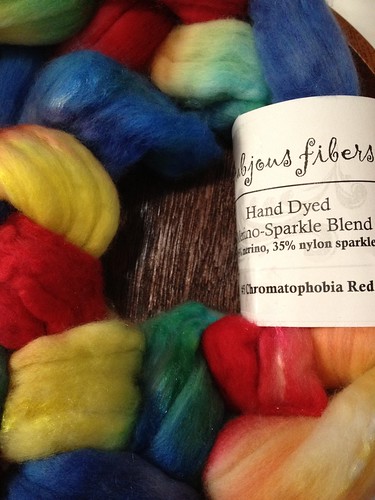
So, in my attempts to become a better spinner, I tackled sock spinning. I took some Frabjous Fibers that was super wash merino and nylon and spun them. (Aren't those beautiful colors?)

IMG_1322

They turned into three lovely bobbins of singles. These were fairly tight twist (or at least I hoped it was tight enough). My ply back tests gave me a fairly tight 3-ply.


For plying, I used the same exact ratio as I did for spinning. (Normally, I go "up" one ratio per plying as we learned in SpinU, but since that normally gives me a balanced yarn, I opted to stay at the same ratio.)

While I was plying, I stopped every now and then to ensure that I was getting enough twist. And yes, the resulting yarn was very 'active' even before it was wound onto the bobbin. I was getting about a 27 degree twist angle.

Here's what it looked like when I wound off the plied yarn onto the skein winder.


During my class at SpinU @ Purlescence Yarns, our instructor, Sandy, told us what sock yarn should look like straight off the niddy noddy or skeinwinder --- a super gnarled mess of spaghetti that you need a heavy weight (like a can) to set. So, I held my breath as I pulled the yarn off the winder.

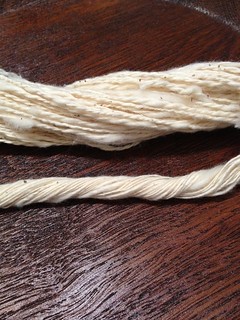
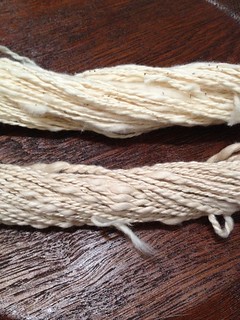
Instead, what I get is only a slight twisty mess. This skein had about 2.5 twists, which is more than my usual-somewhat balanced skeins, but it's not enough twists for socks.

I ended up with about 450 yards of sock weight yarn, but not quite the sock-specific yarn for which I was aiming.  (Here are the left over bits that I navajo plied)


I think I need to go back to my spinning instructor, Sandy, and get some more helpful tips on spinning sock yarn.

Wednesday, March 13, 2013

SpinU: Wrap Up

Since I have spinning on the brain, I realized that I never did a post about the final weeks of SpinU. (Plus I was taking inventory of my handspun, when I came across all of the sample skeins I created.)

For Weeks 11-12, we worked a bit more on Art Yarns, as well as working with luxury yarns, such as bison and cashmere.

It was a class where I really learned a lot and improved on my spinning skillset. It was a LOT of work (with a lot of homework that guaranteed that I was spinning every single night). Often times, there was plenty of spinning just singles so we could ply in class. or maybe some plying as homework for use in other projects. Despite all of the work, it was also a lot of fun. Our instructor, Sandy, was an excellent teacher. My classmates were clever and funny, and we supported each other through every assignment. (Plus, you got to see how other people did --- their frustrations and successes.)

I might take SpinU again in the future to refresh some of what I learned -- because I know I didn't grok some of what Sandy was explaining to us at that time. There was just SO much information that required processing.

If you have a LYS near you that offers something like SpinU, I highly suggest it. For the price, it was a great deal of learning and improving skillsets! (And for those of you in the SF Bay Area, Purlescence Yarns, offers this class (and a "beginners" SpinU) regularly.


Photo Summary of SpinU

Here is photo synposis of the yarns that I spun. Some of these yarns, I've already knitted into garments and am showing the previous photos (and I'm pretty sure I'm missing 1-3 skeins that I spun up for the class!)

Plant Fibers:

From left to right:
  • Cotton Woolen - 2ply
  • Cotton Worsted - 2ply
  • Hemp, - 1ply
  • Flax (wet spun) - single ply
  • Bamboo Bast - 2-ply
And, for the record, I'm not a fan of spinning plant fiber.

Art Yarn Spun:

From left to right:
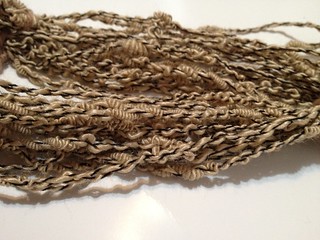
  1. Beehives - black nylon yarn used as a base with tightly plied 2-ply silk to make the beehives.
  2. Encasement Art Yarn - nylon yarn with a motley of feathers, eyelash yarn, etc, used.
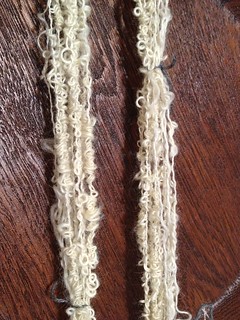
  3. Boucle - nylon base yarn with some generic wool singles
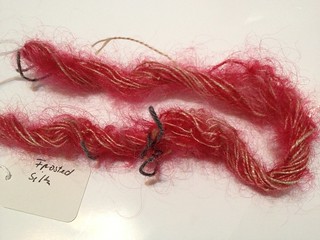
  4. Frosted Yarn - using a 2-ply silk yarn (I spun earlier) and some red fiber


When I brought home the "Encasement Art Yarn", DH thought it looked like Muppet Intestines. LOL . This yarn was a LOT of fun to create, but not something that I would use on a regular basis. But, creating this yarn is really the culmination of every technique that we learned in class.

More Art Yarn: Thick & Thins

Thick & Thin single using a slightly felted top -- I had overdyed some top and it came out every so slightly, which is perfect for this type of art yarn. (I gave this yarn away to one of my classmates.)

Thick Thin after washing2

(L2R)
  1. Thick & Thin Single - Using a batt
  2. Thick & Thin 2ply. Using some of the 1st skein, I made a second thick & thin out of contrasting yarn and plied them together. 


I found that I actually enjoyed making thick & thin yarn from a batt versu the felted top. Sandy suggested maybe weaving with it, so that's what I'm going to do with this one.

Luxury Fibers:

I loved spinning these luxury fibers! I must spin more! Although, admittedly, I wasn't too happy spinning 100% silk. A few strands got into my eye and it was PAINFUL! (One of the hazards of spinning with silk.)

 From left to right:
  • Cashmere/Silk - 52 yards - (1/2 oz) - 30% twist. 16-17 WPI. Ratio 12.5:1
  • Bison (Woolen), 15 yards. -2ply 1/2 oz - Ratio 6.75:1
  • Bison (Worsted) - 20 yards - 2 ply - Ratio: 13.75:1
  • Not shown - 1 and 2-ply silk.


Spinning & Plying

One of the things we learned was how to spin the appropriate size of single for the resulting plied yarn that you wanted. So, if I wanted a 2-ply bulky (~6WPI), I knew exactly what size single I had to spin in order to achieve that bulky yarn. I'd never have to guess what type of singles I needed in order to make the yarn I wanted.

The following skeins were all spun with BFL or Cormo
From Left to right:
  • Woolen 4ply (2oz) - singles with 28-33WPI @ 20% twist,
  • 120 yards 2 ply, singles - 40 WPI @ 30% twist
  •  Worsted 3 ply,  > 30% twist angle


The following were spun with some of Purlescence's "Spin Up & Dye" fiber. What's nifty about using a dyed fiber is that you get to see how the color plays out in different weights & plies.

(L2R): 3Ply worsted; 2 ply bulky
Spin U - Week 5 Splying2-ply Bulky


There was also learning how to make stable singles that could be used for knitting and wouldn't fall apart on you.

(L2R)
  • Brown Merino/Cormo cross - Woolen spun single, 28-32 WPI @ 20 % twist
  • White: 2-ply lace yarn - 115 yards. I "think" this is superwash merino


Specialty Plying:

In addition to regular-old plying, we practiced for specific plying, such as plying with a very tight twist (for socks and such) to navajo to cable plying

(L2R)
  • Red: 3-2 cable ply -worsted  -- akin to Greenland yarn
  • Brown: Very tight twist 3 ply .
Sometimes, having a "balanced" yarn isn't what you want. Socks require extra twist in order to last long, so when they come off the niddy noddy, it might appear to be a mess of curls, but it's crucial to having sock yarn. So, it's good to know when you need tighter twist in your yarn, versus having a "balanced" yarn.


I hope you guys liked the photo summary of SpinU. Again, I highly recommend taking a class such as this to improve your skillset!

Tuesday, December 4, 2012

Spin U: Third Trimester - Weeks 9-10

Week 9

This week, we continued working on novelty yarn spinning, including core spinning. This part was a lot of fun. We leared how to do turkish knots & beehives. We spun up some silk at a very tight WPI and angle so that we could do these techniques.

Sandy provided some nylon core yarn for which to wrap our spun yarn around.

Turkish Knots &; Beehives

Beehives & Turkish Knots

Week 10

As much as I hate knitting with boucle, it turns out that I'm pretty darn good at spinning it. For our homework, we had spun some long wool yarn, which then got turned into boucle for this session.

Boucle

Boucle

Frosted Yarn

Frosted yarn is essentially a form of novelty yarn where you "frost" yarn with roving, mohair, or other fiber. I don't particularly care for this type of novelty yarn either, but it's good to have the technique down.

Frosted

Cotton spinning.

Then, it was onto learning how to spin for cotton. Sandy helped us set up our wheels and demonstrated how to spin with cotton. Then gave us homework to spin cotton.

I hates it I do...

I discovered that I dislike spinning cotton. I *could* do it, but do I want to? No. Sandy had us spinning both worsted & woolen. I prefered woolen over worsted, but that's like saying, I'd rather burn my hand versus burning the bottom of my foot. (Honestly, I'd just prefer to avoid both if at all possible). My DH listened to my swear like a drunken sailor the entire time I was spinning.....

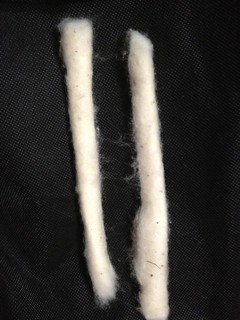
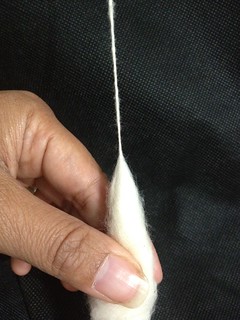
I used a cotton top (worsted) & cotton punis (woolen) for spinning. This photo shows the woolen spinning with the cotton punis.
Cotton Punis Woolen Spinning Cotton Puni
And the resulting yarns?

Worsted Spinning
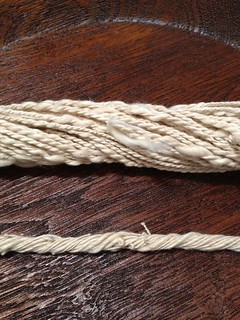
This form of spinning cotton makes for a VERY HEAVY yarn -- as in rope heavy. The yarn itself doesn't feel like rope, but it is heavy.

Cotton - Worsted

Woolen Spinning
Spinning cotton woolen leaves you a much lighter yarn weight for the amount of fiber (which makes sense).
Woolen Cotton

Here they are side by side. You can see how much "denser" the worsted spun yarn (bottom) is compared to the woolen (top)
Worsted / Woolen Cotton


Saturday, May 28, 2011

The Long and Short of It.

Recently, I started working with some mixed BFL that I picked up at Village Spinning and Weaving two years ago. It's lovely fiber with still a nice sheepy smell.

Mixed BFL

I started spinning it on my Joy with my typical short draw. However, I kinda got bored, because there's a pound of it, and I had just spent a great deal of time spinning a lot of Frank.

So I decided that since I really have more yarn in my Stash than I know what to do with, I decided that I would play with the lovely lovely BFL using different draws.

By this time, I had already:
* spun & navajo plied 2 skeins of yarn
* spun short draw a 2-ply (intended for a 4ply chain)

So, I thought to practice my long draw, using the same ratios as before (11:1). It took me a bit to get used to the long draw and just "letting" go control over the yarn. The first bobbin of 1oz singles was very thick and thin but eventually I managed to get it relatively even with very little support from my non-fiber hand.

The 2nd bobbin of 1oz went very well with much more even yarn, although I did have lots of thick and thin sections. The 2ply result was quite nice. It's a worsted weight @ 58 yards with 2 ounces, which isn't much.

But I'm comparing the long woolen draw skein and the short-draw skeins and I'm kinda liking the nice halo effect and the soft loftniness of the woolen. Of course, I'll be knitting up sample swatches to get a feel for the resulting fabric.

BFL

Tuesday, May 3, 2011

Yakkity Yak

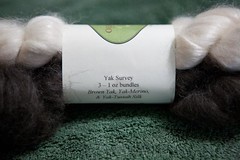
Earlier in March, I spun up a Yak bundle that I picked up over at Stitches West this year.

Yak Bundle

It included three 1-oz bumps of:

* brown yak
* yak merino
* tussah silk & yak

I had trouble with Yak before, and I wanted to get some practice in before spinning up my other yak merino bumps from Abstract Fiber.

So, I pulled out my Ashford Kiwi and set it to a ratio of 14:1. Because yak has such a short staple length, I also criss-crossed the fiber across the flyer hooks so I could get more twist into the fiber before it went onto the bobbin. This worked really well. (Tip learned from one of the Ravelry forums)

The simple brown yak proved the most problematic for me, because of the short staple length. The yak-merino was only slightly better, with the merino adding a little bit longer staple.

The tussah silk/yak had its own challenges. The silk added much needed staple length to the yak, but I don't think it was well blended. I would get areas were it was obviously only yak and so had similar problems with the simple brown yak.

After spinning all 3 bumps, I:

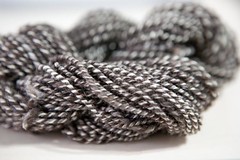
1) spun a 3 ply from each bump - 60 yards

_MG_0816

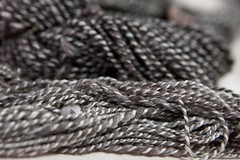
2) spun a 2 ply (yak-merino & tussah-yak) with left overs from Step 1) (14 yards)

_MG_0817

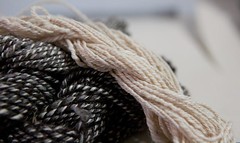
3) navajo plied the remaining tussah-yak (14 yards)

_MG_0821

Of course, with only 87 yards, this doesn't leave me much to work with, so I'm planning on picking up some matching solid yarn to hopefully incorporate making a very very warm hat for someone.

Monday, June 21, 2010

Fiber Exploration

Yesterday, I started spinning this particular fiber.

CVM, Wool. Silk

I took about an ounce to play with to see what it wanted to do. First, I tried to spin it as a low-spun single, like the last one, but it wasn't too happy with that.

Then I tried to see if I couldn't core spin it, but while I liked the look of it, the silk content (nearly 50%) wasn't cooperating. Plus, I think I had the wrong type of crochet thread to use as the core.

Finally, I changed out the ratios to 14:1, and FINALLY, the silk & alpaca were happy with it being spun super/frog-hair thin. And, it looks pretty darn good.

And, I've found that while I like silk, I'm not particularly fond of spinning something that contains 50% or more silk. Nor would I use something that's frog-hair thin -- even plied, this is going to be light laceweight. I'm just more of a fingering / sport / DK weight type of girl.

However, I will finish this particular 5 oz of fiber, and then go back to my beloved wool. I have some cormo sitting and calling my name.

Thursday, June 10, 2010

Spinner's Study: Targhee

The following is part of my continuing spinner's study on various wools.

Information about the Sheep Breed
Targhee Sheep are named after the Targhee National Forest where the breed were developed/grazed. (The forest was named for a chief of the Bannock Indians who had lived in the area in the 1860's.) This is a one of the youngest American breeds; developed in 1926 at the U.S. Sheep Experiment Station in Dubois, Idaho.

Targhee sheep were bred from Rambouillet, Columbia, and Corriedale crosses. This is a dual-purpose sheep developed for meat & high quality wool. This sheep became popular and is now found in primarily in the Western United States -- Montana, Wyoming, South Dakota.

The Targhee is a large sheep and are naturally polled. Mature rams weigh from 200 to 300 pounds. Breeding ewes weigh from 140 to 200 pounds.

Targhee wool characteristics:
  • Considered a fine wool
  • Microns: 22.05 - 24.94
  • Count: 58s-64s
  • Staple length: 3-5inches

My Review: The Good & Bad
I picked up 2oz of Targhee wool from "A Verb for Keeping Warm" in the colorway, "Granite". I'll do a review of AVFKW wool, then a review of the Targhee itself.

The Bad
What I didn't like was AVFKW's dye process. During spinning, a lot of dye bled on my fingers of my drafting hand. I showed it to some fellow spinners who were with me at the time (I was at a spinning event), and they were surprised as well.

In addition, some of the wool seemed a bit felted from the dye'ing process. There were some small sections that just did not draft property and I fought with those parts or just tore them out of the roving. Also, the roving came in two parts: one long piece of consistent roving, then an extra .5 ounces of the same colorway that looked like they just stuffed in, in order to make the whole thing 2 oz. This extra "piece" did not look like it had been accidently ripped off either end of the roving as it wasn't the correct color in the sequence.

As this was my first purchase from AVFKW, it did not impress me.

Once I was done spinning, I washed the whole thing in white vinegar to help set the dye. (I'll probably rinse it with dye AGAIN once it's been knitted up just to ensure that it doesn't bleed)

Targhee Wool: -- The Good.

Despite the problems with the sample I bought, I really liked spinning this wool. It was soft, and didn't mind being spun thinly.

I really liked the colorway from AVFKW, and I wanted to preserve the change in color.

I split the longer piece of roving lengthwise, spun those into 2 bobbins worth singles in the same direction, then did balanced 2-ply with the bobbins.

The resulting yarn is lovely, balanced, and just so utterly soft. I *definitely* want to spin this wool again, but probably not from AVFKW.

1.5 oz. 259 yards of 2ply heavy fingering weight.
Targhee 2ply

Thursday, May 20, 2010

One Turkish Spindle

I've had a hankering to actually *use* the Jenkins Turkish Spindle that I got over at Stitches West -- nevermind I have 3 spinning projects already going (1 on the wheel, 2 on spindles).

I had 2oz of corriedale roving from Spunky Eclectic that was sitting there waiting for me to use. So, last night, I grabbed the Turkish Spindle, opened up Respect the Spindle to the Turkish Spindle section, read up on how to wind onto the arms, how to do a half-hitch...and away I went.

Eventually, I ended up with a bit of yarn.

Jenkins Spindle

Differences
I have to say that it was a lot easier than I had expected -- probably because I already have the basics done. But, having a bottom weight spindle was very different from my other top whorl ones. It's not better or worse, but just *different*.

* the whorl doesn't spin as fast as a top whorl spindle, but it does spin for a lot longer duration -- this takes some getting used to. As a result, the yarn is more loosely spun as woolen, versus worseted. Of course, I've also "dropped" the spindle several times because there wasn't enough twist (versus when I learned the top-whorl, where I had too must twist....)

* I have to make sure the bottom whorl doesn't actually bump into anything, like chair legs. The spacial requirements are slightly different.

* there's no hook, so I have to use a half-hitch at the top of the spindle, which is going to take a bit of practice.

* stopping & winding on the yarn isn't as 'easy' as a top whorl spindle, because I have to unhitch the half-hitch, then carefully wind onto the arms of the whorl.

Of course, I'm sure much of these differences are easily solvable by more practice and getting used to the differences. But other than that, I do like it. I think I might prefer my top whorl a teeny bit better, but again, it's just a different tool for the job.

Friday, May 7, 2010

The Difference of a Few Microns

A bit ago, a friend was helping me to get better at spinning. I had some really good soft and wonderful merino, which I had spun a little bit previously without issue, but I was having trouble spinning "thinner" in order to spin for the project I want. She gave me some faboo superwash merino from Crown Mountain Farms to try.

And, the difference was amazing. I could really tell the difference between the different fibers. The CM Merino was so much softer than the other merino and I was able to draft much easier. Consequently, I was able to spin thinner. She told me that it was going to be easier to spin thinner on very good fiber.

It's not to say that the other merino was bad. It's good merino, but the Crown Mountain was *excellent* merino. Much like the difference between decent wine and EXCELLENT wine.

After finishing about 2 oz of the CM merino, I went back to spin some of the other merino fiber, and it didn't draft as smoothly as the Crown Mountain version, nor was it as soft. But, I was now able to draft it a lot thinner than previously.

And she was absolutely right, it DOES help to learn how to spin *thinner* on very very good fiber. It's made working with the decent merino easier than before.

And, I think I shall have to buy more of the Crown Mountain merino.

Thursday, April 8, 2010

Spinner's Study: Finn

I often fluctuate between trying to get finished objects documented on my blog...or finishing up objects so I can update my blog. It's a whole chicken and egg thing. :-)

But, here's a recent finished spinning project with Finn that I spun up on my Kiwi. I wanted to spin things a little thicker than I had been lately, so I experimented with about 2 oz of Finn top.

First, a bit about Finn:
-----------------------------------------------------
Finn, Finnsheep, or Finnish Landrace Sheep, are among the Nordic breeds from which the Shetland, Icelandic, Romanov and Norwegian Spaelsau originate. All are believed to have descended from the wild mouflon sheep. Finn came from Finland to Canada in 1966 then into the US in 1968. In the U.S, their primary use has been in cross-breeding programs to increase lambing percentage of commercial flocks (as they mature early and breed often)

Finns come in a variety of natural colors with white or black being the most common, but they also come in gray, brown, or fawn. While the fleece is lightweight (5-6 lb.) it is highly praised by hand spinners as it blends easily with other fibers, has a long staple (3-6"), and a wool spinning count in the 50's (24 to 31 microns). Finnsheep fleeces are low-lanolin and high-yeilding fleeces -- averging 70% yield after cleaning.

The American Wool Council ranks Finn wool in the fine end of the medium-wool catagory with a micron range of 23.5 to 31and a staple length of 3 to 6 inches. The wool has a well-defined crimp, a very soft hand (feel) and beautiful luster. Finn wool is extremely popular with handspinnners and is one of the world's most requested wools for felting. It is the most lustrous in its class and is quite different than Shetland and Icelandic wool. Most wools of luster similar to Finn wool are from much coarser-coated breeds. (Finn Breeder's Association)

-----------------------------------------------------
Now, onto my spinning:

I had about 2oz of white Finn top that I purchased from Spunky Eclectic (I had purchased a slew of 2oz of various fibers to try out).


Since I had just finished spinning merino before Finn, this wool felt a bit 'scratchier' (but then again, anything after merino is scratchy). But when I began spinning it, I found it to be quite enjoyable.

Currently, I'm spinning this on my Ashford Kiwi with my largest whorl at 5:5 ratio. As a result, I'm spinning a bit thicker than I have been spinning other wools thus far. I'm spinning it at about a DK-sport weight as a single.

The staple length is about 4-5" long, so I'm experimenting with a "backdraw" worsted drafting instead of a front-draw worseted drafting (since I'd like to learn how to do a long draw later and I want to get used to doing a backdraw). I'm pulling the fiber hand back, while my passive (hand closest to the orifice) slowly lets the twist go into the fiber (and I'm careful never to have twist in the drafting triangle).

I spun up two bobbins of 1 oz of Finn, and created a 2-ply.

Finn

Thursday, March 11, 2010

Spinner's Study: Alpaca & Merino

Alpaca

So, for Ravelympics, I was continuing my spinning study, on alpaca. Needless to say, I'm *STILL* working on finishing that 2 oz of alpaca. This is being spun on a Greensleeves 1.6 oz spindle. I'm not sure if what I have is suri or huacaya, but I had gotten it as part of my original box from Spunky Eclectic. It's a natural tan color.

Ravelympics Spinning


Notes:
- the alpaca is oh-so-buttery soft. It's very well prepared roving.
- the staple length is very *long* = 5-8"
- there's very little crimp in a given lock, so it's not very elastic.

I'm currently spinning it at about a heavy fingering or sport weight, as it seems to lend itself better to that weight. And I'm really really enjoying spinning this fiber.

However, I definitely would like to ply this with merino to give it a little bit of elasticity. I have some pure alpaca yarns, and while I love the drape and the feel, I think it would be better (for me) to mix this in with wool.

Merino
From my Spinner Study box, I have 2 oz of white merino, which is being spun on a Deborah Doyle (Asciano) spindle (1.25 oz).

Deboarah Doyle Spindle


Can I just say that I am *really* liking merino?

Notes:
- lots and lots of crimp, which means that it's.....
- very very elastic. There is definite "sproing" in the spun yarn. I can easily see this being over spun.
- I am currently spinning this at a fingering weight because I want to ply it with the above alpaca, but I can definitely see spinning this a lot thinner (laceweight) just because of the fiber properties.

Some personal notes:
While I like merino, I'm not sure if this will become my "Go-To" fiber (or Desert Island fiber). I find that I'm preferring a little bit of a longer staple length for spinning purposes. This isn't to say that I won't spin merino, but I can easily see this being blended with other fiber types (like alpaca) just to mix things around a little bit.

Thursday, December 10, 2009

Continuing Looking at Wool Types & Micron Counts

Previously on another blog post, I was looking into micron counts and wool types in order to learn about "micron counts" and why they are or not important. I also wanted to research some of the wools that fall into the Fine/Medium/Long (Coarse) categories as suggested by the guidelines so that I would have a better idea when planning on projects on exactly what wool types would be best suited for it.

There are apparently two books on the subject of wool types that I need to acquire:The Knitter's Book of Wooland In Sheep's Clothing: A Handspinner's Guide to Wool.These have been recommended on the Ravelry boards by a multitude of people.
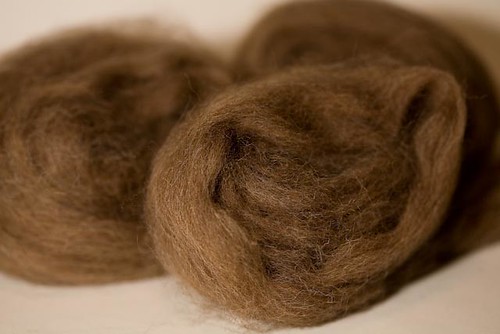
However, Ravelry and the general Internet has been a wealth of information. You just need to go to many sites and piece things together; and even then, you still have an incomplete picture.

But, here's what I've determined thus far in terms of wool (I'm not including things like silk and plant fibers):

Fine wools (16- 22 microns): most Alpacas, Merino, Cormo, Rambouillet, (some) BFL(x), fine shetland(x), camel, angora, possum, quiviut, cashmere, vicuna

Medium wools (22- 31 microns): Corriedale(x), Falkland(x), BFL(x), mohair(x), (inner) Icelandic(x), Shetland(x), Dorset, Cheviot, Jacob

Long wools (31- 36 microns):Romney(x), Wensleydale, Border Leiscter, Lincoln(x)

(X)s mark those wools I've already spun as part of my Spinning Study.

When correlated with the information from the previous post, it gives me an idea of what projects to use with different types of wool:
  • 16-19 Fine worseted & intimate wear
  • 19-23 Apparel, outerwear, quilt batting / felts
  • 23-28 Sweaters, light upholstery coatings, fiberfill
  • 28-32 Upholstery, tapestries, some carpets
  • 32-38+ Carpets, industrial use.


  • Obviously, these are only guidelines. There's nothing preventing anyone from using one type of wool to make something out of the "category",

    Tuesday, November 10, 2009

    Spinner's Study: Shetland

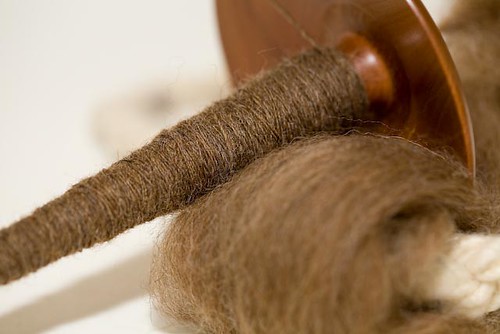
    As a mini-break from the Japanese Maple spinning, I opted to start spinning the lovely brown Shetland I had gotten from Spunky Eclectic

    Shetland Roving

    I had always thought that Shetland was a somewhat scratchy yarn with a high micron count, and I was expecting it to be about the same as the Icelandic wool that I had spun up, but OMG, this stuff is so much softer than Icelandic...almost as soft as merino....not quite, but it's a LOT softer than I was expecting.

    I took a quick look online, and according to the Wild Fibres Website

    Icelandic's micron count: 22-28 for the inner coat 55-65 outer.
    Merino's micron count: 18-24
    Shetland's micron count: 20-33

    So, Shetland *can* be as soft as a decent merino. And the stuff I have is definitely falls in that range. (The merino I am comparing it too is definitely 'softer', but it's pretty darn close.)

    Shetland on Drop Spindle

    As I am still in the "Spinner Study" phase, I have no idea what this will make as of yet. I'm wondering if I should ply it with the merino or lighter brown alpaca that I have. So many decisions!