This past $WinterHoliday, we drove down to see family in the southern part of the state. So, per usual, I packed up my holiday knitting (socks, what else?) along with two spindles and extra yarn (just in case).
I managed to finish 1.5 pairs of socks on the trip (my socks as well as started a new pair for DH).
But, on the way back home, we stopped by Village Spinning & Weaving in Solvang. What a *wonderful* fiber shop. I walked inside and was really pleased. They had a very healthy selection of coned yarn for weaving and a rather ample section of fiber all neatly bagged and assorted. There was a nice assortment of merinos of various counts, BFL, Jacob, different alpacas, colored tops, and assorted luxury fibers (yak, bison.....). They had a gold wrapped ounce of quivit! Oh, and they had some lovely lovely yarn, but I was there primarily for FIBER!
It was like being a kid in a candy store. I didn't know where to start!
Unfortunately, I had totally forgotten my list of what I wanted, so decided to just go with some pretty fibers that caught my eye. I picked up some lovely soft merino, some nicely dyed merino (purples & dark reds), and a LOVELY mottled BFL (oatmeal, dark, and white). I seriously debated on the quivit, but knew that I had no knowledge of spinning short fibers so it would have to wait. However, the already-spun quivit from Musk-Ox farms was SORELY tempting....But I held myself back.
DH started a lively conversation with the owners about sheep and indigenous species, which tangented onto man's involvment in breeding & environments. They were lovely people and very helpful.
So, now, I think I shall have to make this stop on our trips whenever we go and visit family. The shop was lovely, well-organized, and had a healthy selection of fiber-y goodness, AND the owners are just nice, nice people.
Monday, December 28, 2009


Monday, December 21, 2009
Charity Knitting
Charity knitting is a wonderful idea. The thought of knitters getting together to help make the world a better place is great. It combines the love of knitting with the kindness of giving to others less fortunate.
However, this past week, I read on Ravelry someone being "guilted" into doing charity knitting. No one should ever be guilted into doing something they might not be able to do.
Perhaps that one lone knitter doesn't have enough time to complete their own knitting let along anything for charity.
Perhaps they are helping in other ways, by giving a monetary donation or donating time (like helping out in a soup kitchen).
You don't know and can't assume otherwise. And it would be wrong of us to assume that just because they're not doing charity knitting that they aren't otherwise contributing to their chosen charity.
We all love knitting. It provides a relaxing way to unwind and to create something. However when we are *forced* to knit something, we start to look warily on knitting or the knitting groups to which we belong. It's the reason why some knitters don't like to knit gifts -- it causes too much stress and worry to the point where knitting is no longer enjoyable, but a chore. I don't see knitters "guilting" others into gift knitting. So, why should charity be any different?
Charity should be given from the heart and provide the giver a sense of doing good in the world. Being forced to *do* something makes people resent not only the process, but the end product as well. And we don't want someone to resent a charity or their knitting.
We all give in our different ways. We need to respect each others' abilities to do what we can, when we can, and not force the issue just because everyone else is doing it. It makes that person not only resent knitting, but the person or group that is forcing the issue.
And, that is not in the spirit of charity.
However, this past week, I read on Ravelry someone being "guilted" into doing charity knitting. No one should ever be guilted into doing something they might not be able to do.
Perhaps that one lone knitter doesn't have enough time to complete their own knitting let along anything for charity.
Perhaps they are helping in other ways, by giving a monetary donation or donating time (like helping out in a soup kitchen).
You don't know and can't assume otherwise. And it would be wrong of us to assume that just because they're not doing charity knitting that they aren't otherwise contributing to their chosen charity.
We all love knitting. It provides a relaxing way to unwind and to create something. However when we are *forced* to knit something, we start to look warily on knitting or the knitting groups to which we belong. It's the reason why some knitters don't like to knit gifts -- it causes too much stress and worry to the point where knitting is no longer enjoyable, but a chore. I don't see knitters "guilting" others into gift knitting. So, why should charity be any different?
Charity should be given from the heart and provide the giver a sense of doing good in the world. Being forced to *do* something makes people resent not only the process, but the end product as well. And we don't want someone to resent a charity or their knitting.
We all give in our different ways. We need to respect each others' abilities to do what we can, when we can, and not force the issue just because everyone else is doing it. It makes that person not only resent knitting, but the person or group that is forcing the issue.
And, that is not in the spirit of charity.
Friday, December 18, 2009
Night Sky Karius
I finally took some photos of my Night Sky Karius project. I've been a total slacker. It knitted up rather well. The Karius pattern formed some nice striping that I hadn't expected at all. I'm rather pleased with how it turned out.
At first, the knitted fabric from the handspun was a bit 'coarse', but a good soaking in wool wash softened up the handspun by quite a bit.
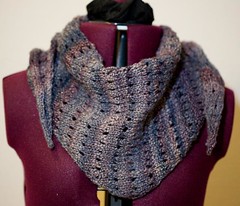

This was spun from my Night Sky handspun that I created for the Ravelry Spindler's SAL.


At first, the knitted fabric from the handspun was a bit 'coarse', but a good soaking in wool wash softened up the handspun by quite a bit.
This was spun from my Night Sky handspun that I created for the Ravelry Spindler's SAL.
Wednesday, December 16, 2009
Re-purpose & Re-use: The making of a cable needle
I'm working on the Trilobyte hat from Knitty.com's Summer '09 issue for my BIL who is a geologist. He has a lot of fossilized trilobytes at their house.
However, it does require cabling, and I walked out of the house without a cabling needle. My crochet hook is just too awkward and long to use and I'm incapable of just taking the stitch to be cabled off the hook without it laddering downwards. I was a tad frustrated at what should be a simple cabling project.
As I was eating lunch with chopsticks, I thought, "Hmmmm....." So, after lunch, I washed said chopsticks and used my scissors to score the wood so I could break it. Then using a handy-dandy pencil sharpener to give either end a point, I made myself a small cable needle.
It works just fine.

Photo taken with my mobile.
However, it does require cabling, and I walked out of the house without a cabling needle. My crochet hook is just too awkward and long to use and I'm incapable of just taking the stitch to be cabled off the hook without it laddering downwards. I was a tad frustrated at what should be a simple cabling project.
As I was eating lunch with chopsticks, I thought, "Hmmmm....." So, after lunch, I washed said chopsticks and used my scissors to score the wood so I could break it. Then using a handy-dandy pencil sharpener to give either end a point, I made myself a small cable needle.
It works just fine.

Photo taken with my mobile.
Letter to Myself
Dear Self,
Starting a last minute gift is probably not the best idea. But you're going to probably try and get it done anyways, right? Not that you need the additional stress and stuff. I don't care if it's a "quick knit". It's not a good idea.
Love,
Me
Starting a last minute gift is probably not the best idea. But you're going to probably try and get it done anyways, right? Not that you need the additional stress and stuff. I don't care if it's a "quick knit". It's not a good idea.
Love,
Me
Tuesday, December 15, 2009
A Day without Knitting?! Perish the Thought!
The other day as I was packing for work, I found myself almost done with a knitting project (with only several rows to go) and realizing that it would only take me a short time to finish.
As I do a lot of my knitting on my daily train commute, this would mean I would finish my project on the train even before I got to work. I'd have *nothing* else to work on for the rest of the day.
Obviously, this was a horror I couldn't imagine going through, so to save myself the hassle, I quickly finished up the last few rows, then cast on another small project that I had thought about starting.
Knitting has saved my already frail sanity on many occasions (when my train was delayed by OVER TWO hours) or when I find myself waiting in line that should have been "fast". Even for short errands, I find myself grabbing one of my knitting project bag (REI ditty bags in assorted colors) and stuffing it into my satchet before heading out the door.
One time, I accidently left the house without my knitting and had to wait...boringly.....bereft of reading material (magazine or book) and felt myself slowly go mad....I vowed *never* to do that again.
I find it amusing that short amount of time that I've been knitting (less than a year), it has become a part of my daily routine. Yet I had been crocheting for the better part of 20 years and it never grabbed my attention like knitting. I surmise it's because extended bouts of crocheting actually cause my hands to ache just a tad, whereas knitting does not.
DH laughs at me sometimes. I brought a knitting project to the movie theatre and I sat knitting during it. He says I've turned into one of those grandmothers that can knit through anything....Now, he barely blinks an eye and just chuckles. He did this the other day when we were at the Dicken's Fair and I pulled a small knitting project out of my muff.
As I've mentioned previously, knitting is a very active form of Zen; something that keeps my hands busy and lets my mind go into a meditative state (that is until I make a mistake or foobar a pattern....but I digress).
It's something I won't leave the house without, much like my wallet, cel phone, or house keys.
I find this particular comic strip rather apt:

As I do a lot of my knitting on my daily train commute, this would mean I would finish my project on the train even before I got to work. I'd have *nothing* else to work on for the rest of the day.
Obviously, this was a horror I couldn't imagine going through, so to save myself the hassle, I quickly finished up the last few rows, then cast on another small project that I had thought about starting.
Knitting has saved my already frail sanity on many occasions (when my train was delayed by OVER TWO hours) or when I find myself waiting in line that should have been "fast". Even for short errands, I find myself grabbing one of my knitting project bag (REI ditty bags in assorted colors) and stuffing it into my satchet before heading out the door.
One time, I accidently left the house without my knitting and had to wait...boringly.....bereft of reading material (magazine or book) and felt myself slowly go mad....I vowed *never* to do that again.
I find it amusing that short amount of time that I've been knitting (less than a year), it has become a part of my daily routine. Yet I had been crocheting for the better part of 20 years and it never grabbed my attention like knitting. I surmise it's because extended bouts of crocheting actually cause my hands to ache just a tad, whereas knitting does not.
DH laughs at me sometimes. I brought a knitting project to the movie theatre and I sat knitting during it. He says I've turned into one of those grandmothers that can knit through anything....Now, he barely blinks an eye and just chuckles. He did this the other day when we were at the Dicken's Fair and I pulled a small knitting project out of my muff.
As I've mentioned previously, knitting is a very active form of Zen; something that keeps my hands busy and lets my mind go into a meditative state (that is until I make a mistake or foobar a pattern....but I digress).
It's something I won't leave the house without, much like my wallet, cel phone, or house keys.
I find this particular comic strip rather apt:
Monday, December 14, 2009
Holiday Knitting
Normally, I'm not the type to do holiday gift knitting, because it's just too much stress on ones nerves. But, this time around, I felt like I needed to make something for that one person, just because. (I'm not mentioning said gift or person until *after* the receive said gift)
I knew what this person's favorite color, and s/he had mentioned being cold during certain times despite the warm weather climate where s/he lived. S/he had tried on a knitted item I had with me and said that s/he might actually wear something like those.
So, knowing that, I got the right color and found a wonderfully quick knitted project. Each of the pair (you get that clue) was a very very easy knit and only took 2 train rides (30 minutes a piece) to finish. There was no complicated stitches, but it wasn't a boring knit either. I made a few changes to the pattern (specifically a gusset) much more to my liking.
Now, they're currently blocking so I can ship them off by Tuesday to the unsuspecting person.
But, if I ever have to do any holiday knitting, this is one relatively quick project that takes less than 1 skein and about 2 hours to make.
I knew what this person's favorite color, and s/he had mentioned being cold during certain times despite the warm weather climate where s/he lived. S/he had tried on a knitted item I had with me and said that s/he might actually wear something like those.
So, knowing that, I got the right color and found a wonderfully quick knitted project. Each of the pair (you get that clue) was a very very easy knit and only took 2 train rides (30 minutes a piece) to finish. There was no complicated stitches, but it wasn't a boring knit either. I made a few changes to the pattern (specifically a gusset) much more to my liking.
Now, they're currently blocking so I can ship them off by Tuesday to the unsuspecting person.
But, if I ever have to do any holiday knitting, this is one relatively quick project that takes less than 1 skein and about 2 hours to make.
Friday, December 11, 2009
The Practicality of Knitted Items
Today's blog entry is about practicality versus beauty of knitted garments.....
Some time ago, I knit myself a variation of the Cigar Gloves (ravelry link). I added 'removable' fingers to the thumb, index, and middle fingers. (They attach on the top of the hand, and I can slip my fingers out of them). I wanted to make them for use on my photography outings, when hands can get cold, but mittens are highly impractical; camera controls *need* to have the deftness of ungloved fingers.
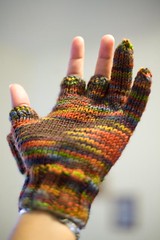
But, I've find myself wearing them on a regular basis despite how "dorky" they look with the dangling fingers because of the practicality of using them.
The other day, I walked into a store to buy part of a birthday gift, and slipped off the fingers in order to pick up a box. The store was part of an enclosed open mall so it was cold in the store, so I didn't want to take my gloves off.
The store clerk looked at my gloves and said, "OMG, those are so practical!".
Now, she didn't say, "Those are lovely!" or "That must have been a lot of work" or "Wow, that's some fancy stitch work!" or "That's beautiful yarn"
I've heard those things about my other knitted projects. This was a brand new compliment indeed, and it took me slightly aback. I thanked her, and admitted that they were quite practical indeed.
Now, granted, I didn't do a lot of fancy cabling or stitching on the the gloves, but the yarn (Socks that Rock Heavyweight) is pretty darn colorful and it's superwash. An important thing when gloves can get dirty when working in the field with a camera.
Admittedly, the dangling extra fingerrs can be rather weird at times, but I've been glad of them on many many many occasions as I slip them over my very cold fingers. Yet, I still hadn't quite expected to hear someone gush about the practicality of my knits.
But, then, I thought about it briefly, especially given the cold weather we've been having lately. What was the purpose of original purpose of knitting? --
The purpose of knitting was to provide someone with something warm, practical, and function to use day to day in a time when commercially available clothing was too expensive or not available. The knitted item might or might not have been 'pretty'. The yarn used to make said item might or might not have been colorful. Practicality & functionality were the primary purpose.
Today, with the advent of so many types of yarn (from luxury wools and silks) and so many colors, we can now choose to make our knitted items works of art.
But many knitted items still serve a practical purpose, especially in cold weather environments. And herein is where the strength of knitted items lie. Imagine going out into the cold blustery day without your scarf or hat or gloves, and only a jacket. How much warmer would you be with these items? I, for one, have been immensely glad that I made my own scarf, hat, and gloves now that the weather has turned. I've made them with nice warm wool and they've been instrumental in my not turning into a popsicle on those particularly cold days.
So, in that sense, noting the practicality of an item is a wonderful compliment.
No, my gloves aren't exactly wonderful work of art compared to some of my other knitted items, BUT, they keep me warm during this cold season and are immensely practical.
Some time ago, I knit myself a variation of the Cigar Gloves (ravelry link). I added 'removable' fingers to the thumb, index, and middle fingers. (They attach on the top of the hand, and I can slip my fingers out of them). I wanted to make them for use on my photography outings, when hands can get cold, but mittens are highly impractical; camera controls *need* to have the deftness of ungloved fingers.
But, I've find myself wearing them on a regular basis despite how "dorky" they look with the dangling fingers because of the practicality of using them.
The other day, I walked into a store to buy part of a birthday gift, and slipped off the fingers in order to pick up a box. The store was part of an enclosed open mall so it was cold in the store, so I didn't want to take my gloves off.
The store clerk looked at my gloves and said, "OMG, those are so practical!".
Now, she didn't say, "Those are lovely!" or "That must have been a lot of work" or "Wow, that's some fancy stitch work!" or "That's beautiful yarn"
I've heard those things about my other knitted projects. This was a brand new compliment indeed, and it took me slightly aback. I thanked her, and admitted that they were quite practical indeed.
Now, granted, I didn't do a lot of fancy cabling or stitching on the the gloves, but the yarn (Socks that Rock Heavyweight) is pretty darn colorful and it's superwash. An important thing when gloves can get dirty when working in the field with a camera.
Admittedly, the dangling extra fingerrs can be rather weird at times, but I've been glad of them on many many many occasions as I slip them over my very cold fingers. Yet, I still hadn't quite expected to hear someone gush about the practicality of my knits.
But, then, I thought about it briefly, especially given the cold weather we've been having lately. What was the purpose of original purpose of knitting? --
The purpose of knitting was to provide someone with something warm, practical, and function to use day to day in a time when commercially available clothing was too expensive or not available. The knitted item might or might not have been 'pretty'. The yarn used to make said item might or might not have been colorful. Practicality & functionality were the primary purpose.
Today, with the advent of so many types of yarn (from luxury wools and silks) and so many colors, we can now choose to make our knitted items works of art.
But many knitted items still serve a practical purpose, especially in cold weather environments. And herein is where the strength of knitted items lie. Imagine going out into the cold blustery day without your scarf or hat or gloves, and only a jacket. How much warmer would you be with these items? I, for one, have been immensely glad that I made my own scarf, hat, and gloves now that the weather has turned. I've made them with nice warm wool and they've been instrumental in my not turning into a popsicle on those particularly cold days.
So, in that sense, noting the practicality of an item is a wonderful compliment.
No, my gloves aren't exactly wonderful work of art compared to some of my other knitted items, BUT, they keep me warm during this cold season and are immensely practical.
Thursday, December 10, 2009
Continuing Looking at Wool Types & Micron Counts
Previously on another blog post, I was looking into micron counts and wool types in order to learn about "micron counts" and why they are or not important. I also wanted to research some of the wools that fall into the Fine/Medium/Long (Coarse) categories as suggested by the guidelines so that I would have a better idea when planning on projects on exactly what wool types would be best suited for it.
There are apparently two books on the subject of wool types that I need to acquire:The Knitter's Book of Wool and In Sheep's Clothing: A Handspinner's Guide to Wool
 .These have been recommended on the Ravelry boards by a multitude of people.
However, Ravelry and the general Internet has been a wealth of information. You just need to go to many sites and piece things together; and even then, you still have an incomplete picture.
But, here's what I've determined thus far in terms of wool (I'm not including things like silk and plant fibers):
Fine wools (16- 22 microns): most Alpacas, Merino, Cormo, Rambouillet, (some) BFL(x), fine shetland(x), camel, angora, possum, quiviut, cashmere, vicuna
Medium wools (22- 31 microns): Corriedale(x), Falkland(x), BFL(x), mohair(x), (inner) Icelandic(x), Shetland(x), Dorset, Cheviot, Jacob
Long wools (31- 36 microns):Romney(x), Wensleydale, Border Leiscter, Lincoln(x)
(X)s mark those wools I've already spun as part of my Spinning Study.
When correlated with the information from the previous post, it gives me an idea of what projects to use with different types of wool:
16-19 Fine worseted & intimate wear
19-23 Apparel, outerwear, quilt batting / felts
23-28 Sweaters, light upholstery coatings, fiberfill
28-32 Upholstery, tapestries, some carpets
32-38+ Carpets, industrial use.
Obviously, these are only guidelines. There's nothing preventing anyone from using one type of wool to make something out of the "category",
There are apparently two books on the subject of wool types that I need to acquire:The Knitter's Book of Wool
and In Sheep's Clothing: A Handspinner's Guide to Wool.These have been recommended on the Ravelry boards by a multitude of people.However, Ravelry and the general Internet has been a wealth of information. You just need to go to many sites and piece things together; and even then, you still have an incomplete picture.
But, here's what I've determined thus far in terms of wool (I'm not including things like silk and plant fibers):
Fine wools (16- 22 microns): most Alpacas, Merino, Cormo, Rambouillet, (some) BFL(x), fine shetland(x), camel, angora, possum, quiviut, cashmere, vicuna
Medium wools (22- 31 microns): Corriedale(x), Falkland(x), BFL(x), mohair(x), (inner) Icelandic(x), Shetland(x), Dorset, Cheviot, Jacob
Long wools (31- 36 microns):Romney(x), Wensleydale, Border Leiscter, Lincoln(x)
(X)s mark those wools I've already spun as part of my Spinning Study.
When correlated with the information from the previous post, it gives me an idea of what projects to use with different types of wool:
Obviously, these are only guidelines. There's nothing preventing anyone from using one type of wool to make something out of the "category",
Wednesday, December 9, 2009
Fabric Goodness
This past week has only been partially filled with fibery goodness, but lots of fabric goodness.
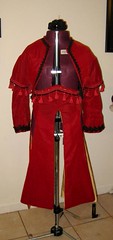
I'm currently working on an outfit for Dicken's Faire, which is an event that runs from the day after Thanksgiving to Christmas eve. It recreates the time in England during Charles Dicken's life. People dress in period appropriate clothing, and the actors stay within the confines of the speech and mannerisms of Dicken's England.
It's a lot of fun. My previous Dicken's outfit needed upgrading, so I worked on creating a Spanish jacket & matching waist belt. I'm currently building up layers of trim on both the jacket & belt.
Of course, this doesn't mean I haven't been knitting or spinning. My knitting bug gets satisfied on my daily two hour commute, plus last night, I took to finishing off a bobbin of two-ply that I had kept putting off.
I'm currently working on an outfit for Dicken's Faire, which is an event that runs from the day after Thanksgiving to Christmas eve. It recreates the time in England during Charles Dicken's life. People dress in period appropriate clothing, and the actors stay within the confines of the speech and mannerisms of Dicken's England.
It's a lot of fun. My previous Dicken's outfit needed upgrading, so I worked on creating a Spanish jacket & matching waist belt. I'm currently building up layers of trim on both the jacket & belt.
Of course, this doesn't mean I haven't been knitting or spinning. My knitting bug gets satisfied on my daily two hour commute, plus last night, I took to finishing off a bobbin of two-ply that I had kept putting off.
Monday, December 7, 2009
That Shrinking Ball of Yarn....
Ever look on with dread at a shrinking ball/cake of yarn and know that your project isn't quite yet done? While hoping that you might have just enough to eek out?
I had that happen to me this past Saturday as I worked on my Lacy Karius project with my handspun. And I realized I definitely was *not* going to have enough yardage.
I love handspun, but if you start to run out of yardage, you can't exactly run to your LYS and find another skein. I had two skeins of yarn (3oz/85 grams and 2 7/8 oz/81 grams) of my Nightsky handspun which totaled about 200 yards. The nice thing about the Lacy Karius/Baktus pattners is that you don't need an exact amount. You knit increases until half the yarn is gone, then knit the decreases.
Unfortunately, I started with the 3oz/85g ball of yarn first and went a wee bit too far past where I should have stopped midpoint before starting the decreases. But, I hadn't thought about it until almost completed. ICK.
So, I had to completely frog back to the half-way point, then frog back another inch or so. Then I started knitting the decreases again. This time, I should have enough yarn (*knock on wood*)
Luckily, this is a relatively fast knit, and I'm almost done with it.
I had that happen to me this past Saturday as I worked on my Lacy Karius project with my handspun. And I realized I definitely was *not* going to have enough yardage.
I love handspun, but if you start to run out of yardage, you can't exactly run to your LYS and find another skein. I had two skeins of yarn (3oz/85 grams and 2 7/8 oz/81 grams) of my Nightsky handspun which totaled about 200 yards. The nice thing about the Lacy Karius/Baktus pattners is that you don't need an exact amount. You knit increases until half the yarn is gone, then knit the decreases.
Unfortunately, I started with the 3oz/85g ball of yarn first and went a wee bit too far past where I should have stopped midpoint before starting the decreases. But, I hadn't thought about it until almost completed. ICK.
So, I had to completely frog back to the half-way point, then frog back another inch or so. Then I started knitting the decreases again. This time, I should have enough yarn (*knock on wood*)
Luckily, this is a relatively fast knit, and I'm almost done with it.
Friday, December 4, 2009
Cozy Bed Warmers
I saw something on Craft magazine that had me intrigued. I, of the perpetually cold feet, needed something to warm up the bed without a wasteful blanket heater (because I always forget to turn it off although the cats love it).
It was a Cozy Bed Warmer that used corn feed from the Pet & Feed store and a bit of fabric.
Well, I have excess fabric in spades, and I always make a trip to our local Pet & Feed Store to pick up food for the cats. On my last trip, I picked up some whole corn feed (about 3-4 lbs) which is incredibly cheap. Then I took some scrap muslin and made myself a Cozy Bed Warmer. I didn't feel the need to make it out of fancier fabric because a) it's not a gift and b) I'm going for functionality and ease of making. Trim? I don't need no stinking trim! Plus muslin was the most copious and easily readible fabric in my whole stash (plus I have quite a bit left over from various mockups)
With cutting and sewing, it took maybe 8 minutes top on the sewing machine.
Love, love, love this thing. It goes into the microwave for about 3 minutes (while I'm brushing my teeth, etc) then gets shoved in under the covers just as I crawl into bed.
It stays warm an incredibly *long* time, and (not) surprisingly, with my feet warm, the rest of me isn't as cold. And of course, the cats love it, and they have a tendency to sleep around my feet now. I can also see using it as a nice warm heating pad for aching muscles.
If I make any more to give as gifts, I'll definitely be using much nicer fabric than my plain muslin, as well as some trim :-)
It was a Cozy Bed Warmer that used corn feed from the Pet & Feed store and a bit of fabric.
Well, I have excess fabric in spades, and I always make a trip to our local Pet & Feed Store to pick up food for the cats. On my last trip, I picked up some whole corn feed (about 3-4 lbs) which is incredibly cheap. Then I took some scrap muslin and made myself a Cozy Bed Warmer. I didn't feel the need to make it out of fancier fabric because a) it's not a gift and b) I'm going for functionality and ease of making. Trim? I don't need no stinking trim! Plus muslin was the most copious and easily readible fabric in my whole stash (plus I have quite a bit left over from various mockups)
With cutting and sewing, it took maybe 8 minutes top on the sewing machine.
Love, love, love this thing. It goes into the microwave for about 3 minutes (while I'm brushing my teeth, etc) then gets shoved in under the covers just as I crawl into bed.
It stays warm an incredibly *long* time, and (not) surprisingly, with my feet warm, the rest of me isn't as cold. And of course, the cats love it, and they have a tendency to sleep around my feet now. I can also see using it as a nice warm heating pad for aching muscles.
If I make any more to give as gifts, I'll definitely be using much nicer fabric than my plain muslin, as well as some trim :-)
Thursday, December 3, 2009
On Saving Money.
With the economy the way it is, I'm trying very hard to stay within the confines of my Stash -- both Fabric & Fiber -- in order to save $$$.
Staying within the Fabric Stash is easy, because I have an entire garage wall full of fabric with which to play, garnered by years of hoarding and purchasing (although in fairness half of the fabric belongs to DH).
Staying within my Fiber Stash is a bit more difficult, because I've tried to contain the yarn to one 32-gallon Rubbermaid bin, and the unspun fiber to a bin half that size. Plus I've only been actively knitting & spinning for less than a year. So I haven't had much of a chance to increase the Fiber Stash as much as the Fabric Stashes. But my LYS is such a place of temptations, plus everyone seems to be having really good sales on fiber/yarn.
And I think, "Wow, that's a good price!"
But even with a good price, you're still spending money ($$$) no matter "how" much you save from the full retail price. And spending money means you're not actually saving any money at all.
I've mentioned my Backlog of Fiber before, which should keep me busy for at least several months without needing to buy additions to the Stash, so says the Logical & Practical part of me. But, that doesn't stop my inner ferret from looking at all the pretty pretty yarn/fiber and squeaking, "PRETTY SHINY!"
Staying within the Fabric Stash is easy, because I have an entire garage wall full of fabric with which to play, garnered by years of hoarding and purchasing (although in fairness half of the fabric belongs to DH).
Staying within my Fiber Stash is a bit more difficult, because I've tried to contain the yarn to one 32-gallon Rubbermaid bin, and the unspun fiber to a bin half that size. Plus I've only been actively knitting & spinning for less than a year. So I haven't had much of a chance to increase the Fiber Stash as much as the Fabric Stashes. But my LYS is such a place of temptations, plus everyone seems to be having really good sales on fiber/yarn.
And I think, "Wow, that's a good price!"
But even with a good price, you're still spending money ($$$) no matter "how" much you save from the full retail price. And spending money means you're not actually saving any money at all.
I've mentioned my Backlog of Fiber before, which should keep me busy for at least several months without needing to buy additions to the Stash, so says the Logical & Practical part of me. But, that doesn't stop my inner ferret from looking at all the pretty pretty yarn/fiber and squeaking, "PRETTY SHINY!"
Monday, November 30, 2009
Holiday Trip Knitting
Whenever I go on a trip, I have to plan out whatever knitting I need to bring. We were driving for this particular trip so I didn't have to worry about bulky or packing effectively, but I did want portability and ease of knit, because there were going to be plenty of younger kids (4-7) around for the holidays, not to mention conversations with the adults. So I needed something(s) that was going to be easy to memorize and the ability to knit while talking...or to stop if necessary due to child antics.
Two projects came to mind:
--> a pair of vanilla socks -- two at a time; toe-up; on two circulars. The pattern was a SideStream master sock from New Pathways for Sock Knitters: Book One by Cat Bordhi.
--> Night Sky Karius shawl -- an easy 8 row pattern with increases in specific areas. Plus, I could use my hand-dyed / handspun yarn (Nightsky handspun)
I started both projects (because I hate casting on in a moving car) and got both to a point where it'd been easy to just pick it up again. I also decided that I would bring two spindle spinning projects as well.
So, I loaded up my Nantucket Knitting Bag (I picked up used on Ravelry) with my 4 projects.
I found myself knitting on the parts of the trip where I didn't need to drive, and during the family get-togethers.
Unfortunately, I had left my generic sock pattern at home (OH NOES!) but some very nice people on Ravelry were able to give me the rest of my Master Numbers (I had my gauge, RPI, and foot sizes, but didn't know the rest) and I was able to finish the sock (sans cuffs) on Thanksgiving Day.
I'm also about 40% done with my Nightsky, knitting most of it during the drive up and down, as it's a relatively easy pattern to memorize. I also managed to get some knitting done while sitting on couches and talking to friends at LosCon. My Nightsky Karius easily fit into my little travel purse so I could leave the large Nantucket behind.
Unfortunately, I didn't touch either of my spinning projects the entirety, but of course, if I had left them at home, I would have desparately wanted them.
Two projects came to mind:
--> a pair of vanilla socks -- two at a time; toe-up; on two circulars. The pattern was a SideStream master sock from New Pathways for Sock Knitters: Book One
by Cat Bordhi.--> Night Sky Karius shawl -- an easy 8 row pattern with increases in specific areas. Plus, I could use my hand-dyed / handspun yarn (Nightsky handspun)
I started both projects (because I hate casting on in a moving car) and got both to a point where it'd been easy to just pick it up again. I also decided that I would bring two spindle spinning projects as well.
So, I loaded up my Nantucket Knitting Bag (I picked up used on Ravelry) with my 4 projects.
I found myself knitting on the parts of the trip where I didn't need to drive, and during the family get-togethers.
Unfortunately, I had left my generic sock pattern at home (OH NOES!) but some very nice people on Ravelry were able to give me the rest of my Master Numbers (I had my gauge, RPI, and foot sizes, but didn't know the rest) and I was able to finish the sock (sans cuffs) on Thanksgiving Day.
I'm also about 40% done with my Nightsky, knitting most of it during the drive up and down, as it's a relatively easy pattern to memorize. I also managed to get some knitting done while sitting on couches and talking to friends at LosCon. My Nightsky Karius easily fit into my little travel purse so I could leave the large Nantucket behind.
Unfortunately, I didn't touch either of my spinning projects the entirety, but of course, if I had left them at home, I would have desparately wanted them.
Wednesday, November 25, 2009
Steeking!
My little dishcloth project has been bound off then steeked. Yaay. It was actually really easy, once I bothered to fully read and comprehend the instructions from Eunny Knits.
Luckily, I used a contrasting purple yarn to crochet the steek stitches up both sides so I could see WTH I was doing.
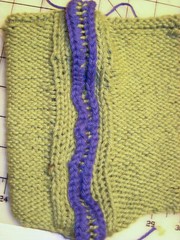
Then I double checked to make sure I had the little ladder as shown in the instructions from Eunny. I had to undo my stitches at least once because I caught the wrong front loops at one point.
Then it was cutting that ladder!
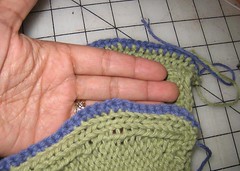
Resulting in a steeked dischloth! So, now I'm relatively confident I can steek a bigger project with minimal fuss.
The two things I learned in this project:
1) the chart I designed does actually work. I have to tweak certain parts of it, but I feel relatively confident that I can put it on the intended project and have it work well.
2) steeking is relatively easy once you get past the "OMG, I'M GOING TO CUT MY STITCHES" phase of it.
Luckily, I used a contrasting purple yarn to crochet the steek stitches up both sides so I could see WTH I was doing.
Then I double checked to make sure I had the little ladder as shown in the instructions from Eunny. I had to undo my stitches at least once because I caught the wrong front loops at one point.
Then it was cutting that ladder!
Resulting in a steeked dischloth! So, now I'm relatively confident I can steek a bigger project with minimal fuss.
The two things I learned in this project:
1) the chart I designed does actually work. I have to tweak certain parts of it, but I feel relatively confident that I can put it on the intended project and have it work well.
2) steeking is relatively easy once you get past the "OMG, I'M GOING TO CUT MY STITCHES" phase of it.
Friday, November 20, 2009
Mending on the Go
This morning while getting off the train, I found that my replacement Dashing handwarmer had started laddering! Oh Noes! Apparently, during a cable twist, I must have dropped and stitch and never noticed.
I had been wearing the glove for about a week now, and never noticed the slow progression of the dropped stitch. So, I grabbed my crochet hook out of my bag (it permanently lives in one of the built in pen pouches), and started to bring the ladder back up. But, then what? I didn't have any of the same yarn to catch it, then weave in the ends, so I opted for the next best thing.
Once I got to the top of the ladder, I relooped the last stitch through the previous row several times to give it a nice firm knot. Then used a bit of spit to felt the knot between my fingers. From the right side, you can't even tell there's anything wrong.
I had been wearing the glove for about a week now, and never noticed the slow progression of the dropped stitch. So, I grabbed my crochet hook out of my bag (it permanently lives in one of the built in pen pouches), and started to bring the ladder back up. But, then what? I didn't have any of the same yarn to catch it, then weave in the ends, so I opted for the next best thing.
Once I got to the top of the ladder, I relooped the last stitch through the previous row several times to give it a nice firm knot. Then used a bit of spit to felt the knot between my fingers. From the right side, you can't even tell there's anything wrong.
Two Color on the Train
Currently, one of my projects is a sample two-color version of Swirling Gauntletts. I've done two color work before on a double-sided knitted project when I first started, but this is the first time of two colors on a single row. I only usually work on this while on the train, which affords me a good 30 minutes of just working the simple cabling pattern without interruption.
So far, so good, and I've learned a lot.
For example, when too tight is too tight. A tip that I read (after I was half-way through this glove) was that you can't pull the yarn too tight or you get puckering. Well, couple pulling the yarn too tight WITH cables (which pulls the yarn even tighter) and you get a LOT of puckering & decrease in size. The middle of the project is a lot smaller than the beginning of the project. So, for the last few rows I've relaxed my death grip on the yarn, and it's starting to even out a bit, which is good.
I've finally figured out how to hold both strands of yarn: the knit stitch in the right hand, and the purl stitch in the left hand (as this is a 2x2 rib). It's a bit slower than my normal knitting speed, but it works. English-style knitting is very weird, but for this project it works.
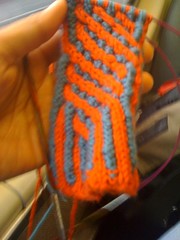
I may or may not make the matching set of gloves for this one. This was really meant to be a sample test with some extra yardage I had left over from my Hexagon Blanket. Plus, it's way too small to fit anyone (except maybe my neices & nephews who are still in the single-digit age bracket).
Of course, this means that I'm going to try my hand at a small Fair Isle project next. :-)
So far, so good, and I've learned a lot.
For example, when too tight is too tight. A tip that I read (after I was half-way through this glove) was that you can't pull the yarn too tight or you get puckering. Well, couple pulling the yarn too tight WITH cables (which pulls the yarn even tighter) and you get a LOT of puckering & decrease in size. The middle of the project is a lot smaller than the beginning of the project. So, for the last few rows I've relaxed my death grip on the yarn, and it's starting to even out a bit, which is good.
I've finally figured out how to hold both strands of yarn: the knit stitch in the right hand, and the purl stitch in the left hand (as this is a 2x2 rib). It's a bit slower than my normal knitting speed, but it works. English-style knitting is very weird, but for this project it works.
I may or may not make the matching set of gloves for this one. This was really meant to be a sample test with some extra yardage I had left over from my Hexagon Blanket. Plus, it's way too small to fit anyone (except maybe my neices & nephews who are still in the single-digit age bracket).
Of course, this means that I'm going to try my hand at a small Fair Isle project next. :-)
Thursday, November 19, 2009
Project Updates
On the Spinning Front
--> I spun up my first two-ply on the wheel, which went surpisingly fast. Normally I was plying on my drop spindle, which takes *forever*. However, my plys on my drop spindle look a heckuva lot better than on my wheel. Of course, this could be because I was plying two totally different thicknesses of yarns......
But I am going to need to practice a lot more on plying, because I seriously see the wheel as a much easier way to ply.
--> I have picked up the Shetland I have currently on my Kundert. I've been ignoring it while I practice on the wheel.
On the Needles
I have three things on the needles still in progress:
1) a dishcloth done in the round that I'm going to steek; it's located next to the computer
2) still slogging my way through the cardigan; for when I need something mindless,
3) a small 2-colorwork glove; for the train ride to work
#1 & #3 are learning projects: steeking & colorwork. I may or may not make the 2nd glove of #3 -- it'll most likely fit my niece or nephew, but it's a nice litle exercise in color work.
Insofar as the dishcloth, I actually charted a simple pattern for it, so it's also the test ground to see if the chart is even do-able or if I need to scale it up in size to make it more obvious. So, in this project, I'm learning two things at once. :-)
In regards to the cardigan, I will most likely NEVER work another cardigan or sweater FLAT again. It will be *in the round* because I am hating all the miles and miles of purls required (as this is a simple stockinette stitch). This is the reason why this darn thing is taking too long.
--> I spun up my first two-ply on the wheel, which went surpisingly fast. Normally I was plying on my drop spindle, which takes *forever*. However, my plys on my drop spindle look a heckuva lot better than on my wheel. Of course, this could be because I was plying two totally different thicknesses of yarns......
But I am going to need to practice a lot more on plying, because I seriously see the wheel as a much easier way to ply.
--> I have picked up the Shetland I have currently on my Kundert. I've been ignoring it while I practice on the wheel.
On the Needles
I have three things on the needles still in progress:
1) a dishcloth done in the round that I'm going to steek; it's located next to the computer
2) still slogging my way through the cardigan; for when I need something mindless,
3) a small 2-colorwork glove; for the train ride to work
#1 & #3 are learning projects: steeking & colorwork. I may or may not make the 2nd glove of #3 -- it'll most likely fit my niece or nephew, but it's a nice litle exercise in color work.
Insofar as the dishcloth, I actually charted a simple pattern for it, so it's also the test ground to see if the chart is even do-able or if I need to scale it up in size to make it more obvious. So, in this project, I'm learning two things at once. :-)
In regards to the cardigan, I will most likely NEVER work another cardigan or sweater FLAT again. It will be *in the round* because I am hating all the miles and miles of purls required (as this is a simple stockinette stitch). This is the reason why this darn thing is taking too long.
Wednesday, November 18, 2009
The Smell of Sheep: Making Connections
As I noted previously, I purchased about 1/2 lb of dark BFL wool to spin up. As I was tearing apart the long roving into sizeable chunks, I noticed the smell.
It was a slight smell, but a smell nonetheless. It was the smell of sheep; albeit it was the smell of clean sheep. (Much like a freshly washed dog smells of clean dog, versus smelly dog).
It was a nice scent, and one that most of my other rovings and tops I had purchased previously did not have..or at least that I noticed. Maybe it was because this was 8 oz of wool versus 2 oz of sample fibers? Maybe because this wool was bagged at the mill versus being separated then bagged at a fiber supply shop.
I met a spinner who once told me that he was able to tell what wool he was spinning by the smell. I don't know if that's true or not, and it would certainly be difficult for me to 'test' at this moment, as I normally buy prepared fiber, versus raw fleeces.
However, I found that I LIKE the smell of the BFL. Admittedly, I sniffed the wool vigorously and have taken quick sniffs whenever I spin it (also keeping it tightly closed in a container, lest the cats decide they like the smell of sheep!)
It reminded me that this fiber came from a living, breathing animal that has frolicked (do sheep frolick?) on some pasture somewhere. I find myself connecting with the wool (and thus, to the animal(s) that provided it) and enjoying the process of spinning that much more.
I think in our modern-every-day life, we are so far removed from the land and the origins of so many of our daily products (food, clothing, etc), that we take for granted what we have. Our lack of 'connection' with our daily wares makes us more of a disposable culture - throwing things away because we have no connection with it.
If we ruin a meal, then it's no problem to go buy the ingredients again. But what about the plants or animals that were harvested or killed to make that food?
I read an article where two chefs went through the process of making goat tacos by picking out the goats from a ranch then watched the butchering process, and taking home the still warm meat. They wrote how they were so much more extra careful in their preparation, because of the process they had gone through and how they felt a connection to that animal. The warm meat on the counter strongly reminded them that this came from a living breathing animal.
Much like the smell of sheep reminds me that this wool comes from a living breathing animal. I mean, I *knew* it did before -- wool comes from sheep after all. But the smell make me seriously GROK that fact. I know that once I finish spinning this wool, then going through the process of making it into a sweater, that it'll mean more than just the time & effort required to spin & knit the sweater; I'll feel that connection to that dark BFL sheep that provided its fleece for my wool.
I think we all need to be reminded that our *things* must come from somewhere; be it a tree that was felled to make our spinning wheels, or a sheep that was sheared for wool....or even a sheep killed to provide a meal. Children should be taken to a farm to show them where our food comes from, or to a mill to show how cloth is made for our clothing.
We need to connect with what we have, to know where things originate from, so that we can truly appreciate what we've been given.
It was a slight smell, but a smell nonetheless. It was the smell of sheep; albeit it was the smell of clean sheep. (Much like a freshly washed dog smells of clean dog, versus smelly dog).
It was a nice scent, and one that most of my other rovings and tops I had purchased previously did not have..or at least that I noticed. Maybe it was because this was 8 oz of wool versus 2 oz of sample fibers? Maybe because this wool was bagged at the mill versus being separated then bagged at a fiber supply shop.
I met a spinner who once told me that he was able to tell what wool he was spinning by the smell. I don't know if that's true or not, and it would certainly be difficult for me to 'test' at this moment, as I normally buy prepared fiber, versus raw fleeces.
However, I found that I LIKE the smell of the BFL. Admittedly, I sniffed the wool vigorously and have taken quick sniffs whenever I spin it (also keeping it tightly closed in a container, lest the cats decide they like the smell of sheep!)
It reminded me that this fiber came from a living, breathing animal that has frolicked (do sheep frolick?) on some pasture somewhere. I find myself connecting with the wool (and thus, to the animal(s) that provided it) and enjoying the process of spinning that much more.
I think in our modern-every-day life, we are so far removed from the land and the origins of so many of our daily products (food, clothing, etc), that we take for granted what we have. Our lack of 'connection' with our daily wares makes us more of a disposable culture - throwing things away because we have no connection with it.
If we ruin a meal, then it's no problem to go buy the ingredients again. But what about the plants or animals that were harvested or killed to make that food?
I read an article where two chefs went through the process of making goat tacos by picking out the goats from a ranch then watched the butchering process, and taking home the still warm meat. They wrote how they were so much more extra careful in their preparation, because of the process they had gone through and how they felt a connection to that animal. The warm meat on the counter strongly reminded them that this came from a living breathing animal.
Much like the smell of sheep reminds me that this wool comes from a living breathing animal. I mean, I *knew* it did before -- wool comes from sheep after all. But the smell make me seriously GROK that fact. I know that once I finish spinning this wool, then going through the process of making it into a sweater, that it'll mean more than just the time & effort required to spin & knit the sweater; I'll feel that connection to that dark BFL sheep that provided its fleece for my wool.
I think we all need to be reminded that our *things* must come from somewhere; be it a tree that was felled to make our spinning wheels, or a sheep that was sheared for wool....or even a sheep killed to provide a meal. Children should be taken to a farm to show them where our food comes from, or to a mill to show how cloth is made for our clothing.
We need to connect with what we have, to know where things originate from, so that we can truly appreciate what we've been given.
Tuesday, November 17, 2009
Learning Projects
Since I'm a relatively new knitter, there's a lot of things I don't know how to do yet. What I've found that if I make something that teaches me a new technique, I get a finished product AND learn a new skill at the same time.
This is the reason that I am partial to dishcloths. They are relatively simple, require a relatively cheap form of yarn (cotton), and dischcloths are knit up quickly with minimal effort.
Currently, I am learning to do two different things on my dishcloth:
1) I am "testing" a chart of a design I created. I think it'll work, but it might need a bit of tweaking..
2) Steeking. I've heard a lot about it, and I *like* doing things in the round (I detest miles of purling as I have learned as I am currently knitting a cardigan "flat" and it seems to be taking forever!)
I originally learned of it, by listening to the Stitch It! Podcast when I first starting to knit. I was curious about it, but felt that I should probably learn the basics first. Now, it's time. :-)
So, I cast on the dishcloth in the round with a 3-border stitch using some generic cotton yarn I picked up at Joann's with a coupon. I'm about halfway through the discloth -- which is my sitting at the computer knitting because it's pretty brainless -- and I'm looking forward to steeking it!
I've found a good website on steeking, which I'll be making use of later: Eunny Knits on Steeking.
Oh, and after doing a bunch of Google searches, including a browse through Ravelry's Stitch It Podcast forums, the website is the one most often referred to when it comes to steeking.
This is the reason that I am partial to dishcloths. They are relatively simple, require a relatively cheap form of yarn (cotton), and dischcloths are knit up quickly with minimal effort.
Currently, I am learning to do two different things on my dishcloth:
1) I am "testing" a chart of a design I created. I think it'll work, but it might need a bit of tweaking..
2) Steeking. I've heard a lot about it, and I *like* doing things in the round (I detest miles of purling as I have learned as I am currently knitting a cardigan "flat" and it seems to be taking forever!)
I originally learned of it, by listening to the Stitch It! Podcast when I first starting to knit. I was curious about it, but felt that I should probably learn the basics first. Now, it's time. :-)
So, I cast on the dishcloth in the round with a 3-border stitch using some generic cotton yarn I picked up at Joann's with a coupon. I'm about halfway through the discloth -- which is my sitting at the computer knitting because it's pretty brainless -- and I'm looking forward to steeking it!
I've found a good website on steeking, which I'll be making use of later: Eunny Knits on Steeking.
Oh, and after doing a bunch of Google searches, including a browse through Ravelry's Stitch It Podcast forums, the website is the one most often referred to when it comes to steeking.
Subscribe to:
Posts (Atom)