Wednesday, April 21, 2010

Casting On!

I love starting a new project; it's like sitting down to a new dessert that you know will be absolutely fabulous!

I had been pretty monogamous with my Mondo Cable Pullover, but have been jones-ing for a pair of socks for the past month, but I knew that if I put down the sweater, I wouldn't get back to it in a timely manner.

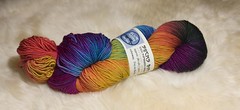
The day after finishing the pullover, I cast on for my 'vanilla' pair of socks (Cat Bordhi's Coralis sock pattern) with some Blue Moon medium weight sock yarn I had.

_MG_0006


When I put the skein onto the swift, it looked like a veritable rainbow of colors. I loved looking at it. The resulting cake wasn't too attractive, but I'm keeping in mind the colors I saw on the swift. These will end up being a rainbow or "clown" socks, but I like having the motley of colors, especially after having only a few thousand stitches only in shades of red --- not that I don't like red; I love red, however, I do like variety!

I'm already 1" up on the toe.

Tuesday, April 20, 2010

Mondo Cable KAL

I *finally* finished the Mondo Cable pullover late, late, late last night. I had a heckuva time with the neck band following her instructions. It just wouldn't come out correctly on one side. So I had to frog it at least twice.

(This is probably me not understanding her instructions because everyone else seems to grok it well enough). However, on the left hand neck edge, everything worked out well, and I could see what Bonne Marie wanted to do.

So, I just replicated that affect (which reminded me a lot of entrelac -- something I am wholly familiar) on the right hand neck edge.

And it worked beautifully. I tried it on last night and it fit perfectly, which pleases me to absolutely no end.

This morning, I wove in most of the ends, washed the sweater (which needed it after being dragged around for the past month), and set it out to dry. It really didn't need blocking -- I had steam blocked the body ribbing and it no longer curled.

AND NOW, since I had been so darn monogamous with this project, I get to work on a pair of socks! I wound a skein into a cake and cast on my favorite vanilla pair of socks with some very colorful Blue Moon medium weight.

Monday, April 12, 2010

Mondo Cable Pulli: KAL

Last night, I had my very first set-back on the Mondo Cable Pullover. I had modified the sleeve pattern slightly to include extra stitches for the left sleeve, and thought those modifications would suffice for the right sleeve.

However, I did not remember that my right bicep is ever-so-slightly bigger than my left bicep, which can make a huge difference when doing a somewhat closely fitted garment. When I sew, I always have to accommodate for a difference in sleeve sizes for both arms; I don't know why I thought knitting would be any different?

So, when I tried it on when the sleeve was mid-forearm, the bicep was a bit too snug for comfort. I thought that maybe blocking would "fix" the problem, but I opted to just rip back as while blocking fixes some things, it would be better if I just corrected the problem.

Luckily, I had put lifelines in at various places, so I ripped back to mid-bicep (about 4-5 inches) on the sleeves and just added about 2 more inches from the previous increase. After trying it on, the bicep area felt much more comfortable when wearing it.

While 4-5 inches might not seem like a lot, it's taking me FOREVER to get through this project, so it represents about 2-3 days worth of progress. Oh well.

Currently, I'm at elbow-length and doing normal decreases at this point.

So note to self: lengthen out the number of rounds before each decrease on the right sleeve.

Thursday, April 8, 2010

Spinner's Study: Finn

I often fluctuate between trying to get finished objects documented on my blog...or finishing up objects so I can update my blog. It's a whole chicken and egg thing. :-)

But, here's a recent finished spinning project with Finn that I spun up on my Kiwi. I wanted to spin things a little thicker than I had been lately, so I experimented with about 2 oz of Finn top.

First, a bit about Finn:
-----------------------------------------------------
Finn, Finnsheep, or Finnish Landrace Sheep, are among the Nordic breeds from which the Shetland, Icelandic, Romanov and Norwegian Spaelsau originate. All are believed to have descended from the wild mouflon sheep. Finn came from Finland to Canada in 1966 then into the US in 1968. In the U.S, their primary use has been in cross-breeding programs to increase lambing percentage of commercial flocks (as they mature early and breed often)

Finns come in a variety of natural colors with white or black being the most common, but they also come in gray, brown, or fawn. While the fleece is lightweight (5-6 lb.) it is highly praised by hand spinners as it blends easily with other fibers, has a long staple (3-6"), and a wool spinning count in the 50's (24 to 31 microns). Finnsheep fleeces are low-lanolin and high-yeilding fleeces -- averging 70% yield after cleaning.

The American Wool Council ranks Finn wool in the fine end of the medium-wool catagory with a micron range of 23.5 to 31and a staple length of 3 to 6 inches. The wool has a well-defined crimp, a very soft hand (feel) and beautiful luster. Finn wool is extremely popular with handspinnners and is one of the world's most requested wools for felting. It is the most lustrous in its class and is quite different than Shetland and Icelandic wool. Most wools of luster similar to Finn wool are from much coarser-coated breeds. (Finn Breeder's Association)

-----------------------------------------------------
Now, onto my spinning:

I had about 2oz of white Finn top that I purchased from Spunky Eclectic (I had purchased a slew of 2oz of various fibers to try out).


Since I had just finished spinning merino before Finn, this wool felt a bit 'scratchier' (but then again, anything after merino is scratchy). But when I began spinning it, I found it to be quite enjoyable.

Currently, I'm spinning this on my Ashford Kiwi with my largest whorl at 5:5 ratio. As a result, I'm spinning a bit thicker than I have been spinning other wools thus far. I'm spinning it at about a DK-sport weight as a single.

The staple length is about 4-5" long, so I'm experimenting with a "backdraw" worsted drafting instead of a front-draw worseted drafting (since I'd like to learn how to do a long draw later and I want to get used to doing a backdraw). I'm pulling the fiber hand back, while my passive (hand closest to the orifice) slowly lets the twist go into the fiber (and I'm careful never to have twist in the drafting triangle).

I spun up two bobbins of 1 oz of Finn, and created a 2-ply.

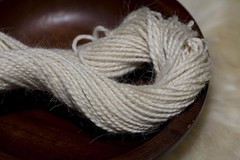
Finn

Wednesday, April 7, 2010

Mondo Cable Pulli

Currently, I'm still plugging along the Mondo Cable Pullover (KAL).


(The Mondo Cable 2nd Sleeve)

March 28th -- I finished the body on March 28, and used the prescribed 5/1 ribbing on smaller needles. I've also picked up the sleeves and worked on a few rounds. I increased the initial stitch count by 2 on the sleeves because I work out and my biceps are…well, large for my size. (Whenever I sew, I always have to modify the armscye & sleeves.)

March 29th -- Well, the sleeves are going a lot faster than the body. I tried on the sweater just before the 1st Decrease, and realized that if I followed the rest of the pattern, the sleeves would have almost no ease and maybe even negative ease..

So, I added another 4”, before started the 1st Decrease. And I’ve mapped out where to put the other decreases (approximately every 10 rounds with my modifications) so that it comes to the right length with approximate finished stitch count. I added a whole bunch of lifelines at various places just in case I need to frog back.

April 4th -- I finished the first sleeve. I shortened the sleeve just a tad and used a 4-2 ribbing (on same size needles) instead of the 5-1 ribbing (on smaller needles), and after trying it on, it’s only a tad bit longer than perfect, which is okay by me.

I’ve picked up the stitches on the second sleeve and am into the first few rounds. I’m still loving the pattern and will definitely make more. (It’s just a matter of having time to knit nowadays!)

Tuesday, April 6, 2010

Spinning a Japanese Maple

So, a while ago, I received this fiber & spindle from Butterfly Girl Designs:

Butterfly Girl Spindle & Japanese Maple roving
Japanese Maple - 70% merino, 20% bamboo, 10% nylon firestar


It reminded me of a Japanese Maple in the fall. Much like this:

(BTW, I love Japanese Maple Trees)

I used the pictured drop spindle to turn it into this:

Japanese Maple


And then, the poor fiber sat resting all this time, because I wasn't sure what to do with it! I wasn't 100% happy with how it turned out, because the colors (at least to me) seemed muddy, even though I loved the fiber colorway. I wanted more of the gold to pop.

However, I know that sometimes how the fiber looks prepared is a bit different from how it might spin up...or even how it might knit up. So, I wasn't ready to trash the project.

I debated plying it against itself or maybe spinning something to match or maybe a commercial yarn. In perusing through my stash, I remembered that I had this:

Jagger Main line Merino Gold
Jagger 100% Wool Cone -- 5000 yards


Certainly, I could spare a few hundred yards for this project? LOL. The coloration was close enough to the gold bamboo in the batt, so I opted to give it a go. So, I prepped up the Kiwi wheel for plying.

And at first, I wasn't too happy with how it looked, except for certain spots. But I opted to keep trying. I *knew* that the gold would bring out the colors and to trust myself on my knowledge of color theory. My plying wasn't the greatest, but a little help from Jasmin and I got this....


Japanese Maple

I am definitely in love. The gold really made all of the colors pop and tied everything together. I currently have 495 yards of laceweight/fingering weight yarn. Plus, I still have some of the batt left over. I think I might be able to squeeze another 50-60 yards out.

And think I've found the *perfect pattern* to go with the yarn. I'm not wholly sure how well this yarn will look in this pattern. So I will try a pattern swatch. Now, I just have to figure out how to knit up this pattern (coz after reading it, my head is spinning!)

Wednesday, March 31, 2010

Truckers take up Knitting & Quilting

The Wall Street Journal put up this article the other day about truckers taking up knitting & quilting as ways to pass the time while waiting for new loads.

I think it's pretty damn awesome.

Monday, March 29, 2010

Travelling with Needles

For those of you travelling relatively soon, Another Long Yarn has some good information regarding travelling with knitting needles since the underwear bomber scare.

Flying with Knitting Needles

Friday, March 26, 2010

Mondo Cable Pullover: Update

Back at the beginning of March, I started the Mondo Cable KAL with the Knitmore Girls over on Ravelry.com.

It's been a slow steady slog in creating this sweater, as my knitting time has drastically been reduced over the past several months. And, I've been helping to bring up the rear in the KAL. I know that the KAL is not a race, but it's often hard to see all the completed photos of everyone's sweater while still plugging away on my own.

3/10/10 -- I've 1-2 rows from joining the front of the pullover.
3/15/10 -- I've gotten past the 2nd cable cross of the pullover.
3/19/10 -- I've done the 3rd cable cross, and have tried on the fit. So far, so good
3/24/10 -- I've done the last & final cable cross, and have about 2 inches left before I start the ribbing. I'm actually really close to finishing up the first skein!
3/25/10 -- I wound the 2nd skein up into a ball in anticipation of finishing the first skein. (OMG that was a lot of yardage to wind! And my poor ball winder can't handle the yardage in a cake.)

I am a bit worried about the ribbing, as people have reported 'curling'. Gigi of the Knitmore Girls used the same size needle and went to a 4-2 rib and had no issues. But Bonne Marie posted this tidbit on her blog:

For those of you knitting along (wave to the Knitmore Girls KAL!!), you can see that the bottom of this sweater is pretty well-behaved. I used my steam iron and pressed the bottom from the wrong side. No rolling! If you are having that issue, try this AND also consider going up a needle size for your ribbing because your gauge might be too small in that area, if it flips. Also — bind off LOOSELY.

Top down sweaters need to have the same give at the bottom as a cast-on for a bottom-up sweater. So in the casting off, knitters need to be mindful of their tension in that area. Go up a needle size or two JUST to work the bind off. In this case, I used a #7 needle for the body, a #6 needle for the ribbing, and because I have that tight bind off problem, I went back up to the #7 when it was time to cast off the hem.


I really do love the pattern thus far. I was a bit worried about the size I had chosen, but it fits perfectly (thus far). I definitely will be making more of this sweater.

Thursday, March 25, 2010

Carrying My Knitting -- and the Nantucket Knitting Bag

I'm a sucker for bags...of any sort. I have a collection of photography bags, travel bags, etc. However, I haven't exactly succumbed to getting a collection of knitting specific bags, such as Namaste, Lexie Barnes, and such.

Why? Because they aren't really my style. I don't really like "purses", but rather utilitarian bags that I can carry a book, water bottle, notebook, knitting (of course), and maybe a drop spindle & extra fiber.

Now, Timbuk2 messenger bags or Eagle Creek bags are more "me". And I use those on a regular basis and it fits everything that I want.

For day-to-day carrying projects: knitting projects are placed in Stuff sacks (aka Ditty bags) then placed in the main bag. The stuff sacks are often made of rip stop nylon so needles don't poke out, and the bright colors make them easy to find. I have several in different colors so I can easily grab a project and "go".

In addition:
-- Notions are placed in a small clear plastic makeup bag.
-- Fiber is placed in zip lock baggies
-- the spindles are placed in camera lens bag or wine carrier case (which I found at a local thrift store for cheap!)

However, I did pick up one bag, the Nantucket Knitty Bag, which has worked really well for me thus far. Currently, I use it for long extended road trips in the car or for taking projects with me to "Stitch & Bitches".

The original bag was designed for use by carpenters who need all those pockets for tools, but it works really well for placing all of your knitting & spinning supplies in as well!

Yarn on the inside
(The photo is from the manufacturer site. My Nantucket is black.)

The bag measures: 15" x 10" x 6" with 1.25" handles. You can sling it like a shoulder bag, or close up the top and use it as a back pack. You can also reverse how it zips up so that all the pockets are in the inside of the bag. (I did this when visiting a house with small children).

It easily fits multiple projects, multiple yarn & fibers, and has wonderful pockets for putting in things such as full-size scissors, measuring tape, etc. It's easy to pull things in and out of it, and I can stuff it relatively full without worry.

I've been using it for car trips. For one week-long trip I carried: three sock projects, a sweater project, a hat project, all the associated yarn for said projects; two spindles and fiber for spinning. Then all the assorted tools that got placed in the pockets. It fits nicely at my feet on the passenger side, and the wide open mouth lets me immediately place in a project without any fuss.

When I'm not using it for car trips, it just simply holds yarn or fiber or whatever I'm currently working on at that particular moment, and will often get carried room to room when I'm knitting. (This is an addition to my static yarn baskets that sit by my favorite chairs.....)

The only thing about this bag is that, depending on how full you stuff it, the top won't cinch close all the way, and if it topples over, you might spill your yarn/fiber/projects out. However, I don't normally stuff it that full, so this hasn't been a problem for me.

Overall, it's a lovely bag to use.
Wednesday, March 24, 2010

Old Tech Meets New Tech.

I love my drop spindles because they are really portable....much like my knitting. There are often situations where I can't knit because I know I'm going to get interrupted and I need to concentrate, OR when my project is just too big to pull out to knit comfortably (in this case, a sweater). These are the occasions when I pull out my drop spindle, because I don't really need to concentrate when using it, it relaxes me, and I can literally stop at any time.

In this particular instance, I had gone to the Apple Store to see about a repair on my iPhone. I got help right away, and was simply waiting for the clerk to return. The Apple Store is full of shiny tech things, but there isn't much there that I haven't already seen (and frankly didn't need).

I realize the irony of pulling out an ancient piece of technology in a place where some of the most modern technologies can be purchased quite easily. And for the most part, I was mostly ignored as many people were too engrossed in playing with the latest toys. I was spinning merino top on my Asciano spindle.

However, it was the salespeople that eventually came over to ask what I was doing and gawk somewhat. One gent was keenly interested, and when I started explaining all about the physics of spinning, he was super eager to run out and try it out for himself. LOL.

Eventually, I got my iPhone all sorted out, packed up my spindle, and was on my merry way.

Tuesday, March 23, 2010

A Neat Commercial

This commercial is kinda awesome.


as is the making of the commercial (where you also see a crochet hook in action)

Monday, March 22, 2010

The Art of Collecting Spindles

If you hit the Ravelry Spindlers Forum, Flickr Groups (such as SpindleShots), or whatnought, you'll notice that there are a LOT of spindle collectors out there.

It's much easier to collect spindles than it is to collect wheels (not to say that there aren't people who collect wheels!), but spindles take up considerably "less" space than several wheels. (Of course, if you have 100+ spindles, it might take up plenty of room!)

Of course, this is not a new phenomena. In Ancient Greece, spindles of gold & ivory were presented as gifts to women, and many have been found in the tombs of both men & women alike as burial items across various cultures. But, whether or not someone had dozens or even hundreds of spindles (if you weren't a professional spinner) is probably up for debate. I suspect that most ancient spinners might have had a small collection for utilitarian purposes, but not to the extent some spindlers have today!

Butterfly Girl Spindle & Japanese Maple roving
Resin Spindle


Spindle whorls have been created out of beads, shells, wood, ceramics, stones, bone, precious metals, semi-precious stones, and clay. Many are decorated with intricate carvings or ornate designs. And this doesn't include the modern day interpretations, such as resins, glass, and wood spindles with gold rims, etc! (I sometimes wonder what future archeologists & anthropologists will say when they uncover these tools and how they will compare it to *our* ancient forebearers.)

ZebIsis Design Spindl
Jasper Whorl Spindle


It seems to me that humans have been trying to spruce up their utilitarian tools to make them more pleasing to the eye when using them. I know I find an immense pleasure in just seeing my pretty spindles whorl in such a plethora of wide colors & patterns.

Butterfly Girl Murano Drop Spindle
Murano Glass Spindle


Insofar as myself, my collection isn't *that* big. I might have 7 spindles total, of varying materials and weights. But this doesn't mean I won't be acquiring more spindles in the near future.......

(And for now, I'm sticking with *one* wheel!)

Friday, March 19, 2010

Book Review: Spin Control by Amy King

I've just finished reading Amy King's Spin Control Book. And as a relatively new spinner, I definitely like this book. It's geared primarily towards those spinners with wheels, but the techniques can be converted to those using spindles with a bit of care.

In the beginning of the book, she goes over some spinning basics -- the differences between woolen versus worseted, S-spun / Z-spun, short draw versus long draw, and the different fibers and how they react to certain spinning types. And she has some wonderful color photographs showing how a woolen yarn knit up looks to a worsted spun yarn. In addition, she goes over tips & techniques to help you get your yarn more consistent. She does not go in-depth about some basics, so if you're looking for details, this is probably not the book.

She also goes over plying and the different plying techniques. And again, lots of wonderful photographs showing how a 2-ply or 3-ply pr N-ply does with regular knitting versus cabled knits versus colorwork.


The last few remaining chapters of the book go over the possibilities of what you can do with your handspun, including core spinning, making boucle, and purposefully made 'art yarn'.

The photographs in the book are very well done, and give you a nice view of what can be accomplished and provide a 'guideline' on how things might spin or knit up. The writing style is laid back and easy to read. There's no overly complicated instructions and a lot of the step-by-step instructions are accompanied by photographs.

I have heard that more advanced/experienced spinners might not find a lot of value in the book, but I'd say for beginning/intermediate spinners, this book can show you all of the possibilities and help you get to the next level in your spinning.

Thursday, March 18, 2010

A Bit of History: Part III - Crochet History

This is the 2nd part of a 3-part post regarding a little bit of history on some knitting & crocheting as presented for the Nova Albion Steampunk Exhibition workshop on Fiber Arts. (Obviously, this is not a comprehensive history, but serves merely as a primer, and my time line *stops* at the Victorian era).

Part I: Victorian Fiber Arts -- can be found here.
Part II: Knitting History -- can be found here.


CROCHET HISTORY

The exact origins of crochet are unknown as there are no surviving examples. The first mention as *shepherd's knitting* from "The Memoirs of a Highland Lady by Elizabeth Grant" in 1812, and the earliest published crochet pattern was around the 1820s. It has been theorized that crochet might have started as early as the 1600's and originated around Arabia and parts of Asia.

Around the 1800s, crochet became a cottage industry, especially in Ireland, was an inexpensive substitute for lace. As crochet was a cheap copy of the the more expensive (and thus status symbol) of lace, it was branded as "common". However, Queen Victoria helped its reputation by purchasing Irish made crochet lace, and learned to crochet herself.

Crochet became a popular leisurely pursuit for ladies. There are a lot of patterns available for making everything from crocheted lace copies to clothing. Crochet hooks ranged from crude wood to ivory hooks.

REFERENCES, LINKS & SAMPLE PATTERNS

Wednesday, March 17, 2010

I have an addiction.....

My name is J. And I have a Fiber addiction.

I keep looking at lovely fiber pr0n on Ravelry and Etsy, and drool at the sight at some lovely fiber combinations...DESPITE having a decent Fiber Stash(TM) that should last me for at least several months, IF I spin on a regular basis. I think to myself, "So much fiber, so little time...."

Not only do I have a fiber addiction, but I keep looking at knitting patterns on Ravelry.com, and keep adding favorites of those I might want to make someday. I think, "So many patterns, so little time...."

And, all of these addictions are due to Ravelry. I think I might be a Ravelholic. I know I definitely need help.

Now, if you'll excuse me, I need to peruse Ravelry for a Ravelry Anonymous group......

A Bit of History: Part II - Knitting

This is the 2nd part of a 3-part post regarding a little bit of history on some knitting & crocheting as presented for the Nova Albion Steampunk Exhibition workshop on Fiber Arts. (Obviously, this is not a comprehensive history, but serves merely as a primer, and my time line *stops* at the Victorian era).

Part I can be found here.


KNITTING HISTORY

Knitting hasn't been around as long, as say, spinning or weaving. The word "to knit" wasn't added into English until the 1400s. There are knitted fragments, but it's hard to know if it was really "knitting". There are examples of "nalbinding" (cross between tatting, knitting, and crochet).

Socks are the oldest form of knitted garments found, especially tubular (in the round) knitting (Egyptian socks 1000CE - stockinette done in shades of white & indigo with Arabic decorations -- made out of COTTON.) In the Middle East, the materials available were cotton & silk ...not necessarily wool.) In the 1600s, Britain became the biggest producer of handknitted worseted stockings that were exported around the world (knitted on 4 needles)

The knit stitch is the earliest form. Purl stitches were verfied in usage in 1562, and were mostly used for decoration purposes (not for welts or ribbing)

Examples of early knitting:
• pillow 1275 in Spain.
• Gloves from 1200s.
• Paintings from 1350s show some form of knitting.
• V&A example of 16th c gloves knitted in Spain. (knitted in the round)
(You can see some of these at the V&A Museum pages)
• Carpets are often found as examples of handknitting in the 1500-1600s.

14th - 16th Century: A cottage industry of knitting appeared in about 1420s, which also heralded the start of wool knitting. Previously, knitting was done with whatever fibers were the most readily available -- cotton, silk, etc.

In medieval times, knitting was guild controlled craft, and was a mainstay of exported goods (14-15thc). Sailors knitted for the same reason we do today -- it's portable, small, and gave them something to do on their long trips. This also spread the art of knitting.

Industrial Revolution in the 18th century -- transformed knitting into an automated process. Hand knitters found it difficult to make a living, as automation made cloth & clothing cheaper. There were still a few cottage industries of knitting, specifically in Scotland and the Fair Isle sweaters.

However, by now, knitting was slowly turning into a leisurely pursuit.

1800s -- Knitting was considered a more leisurely pursuit, suitable for ladies to pursue. It was also suitable for helping to decorate clothing, as well as hide any alterations of various hand-me-down clothing (along with other trim from ribbonwork, crochet, etc). Amusingly enough, there were knitting techniques that mimic'd crochet (such as picot knitting!)

There were a lot of instructions & patterns as yarn makers & embroidery houses published books to highlight their products (which hasn't changed much from today's current yarn catalogs & websites). There were also a lot of books & magazines geared towards women and teaching them these fine arts (again, this hasn't changed much!)

In the mid 1800s, beaded knitting was introduced and became widely popular, esp. in America, where ladies knitted beaded handbags.

Around the 1870s, knitting was taught to both boys & girls as part of their education, as part of a "useful skills" curriculum in schools for the working classes

By mid 1890s, knitting was considered "passe", but was still encouraged as a leisurely pass time for ladies.

There are still a lot of surviving patterns & books the Victorian era that you can easily find in Libraries or Google Books

Links of Interest

(next post: Crochet History)

Tuesday, March 16, 2010

A Bit of History: Part I - Victorian Fiber Arts

I had actually put together a whole bunch of notes for the Nova Albion Fiber Arts panel. As I am a former teacher (and history buff), I decided that knowing a bit of history was a good starting point. (Obviously, this is not a comprehensive history, but serves merely as a primer, and my time line *stops* at the Victorian era).

This is a 3-part series. So, without further ado....


A Bit of History Fiber Arts....


Victorians loved their crafts, including:
• cross stitch
• embroidery
• knitting
• tatting/netting/knotting -- a form of lacework
• Braid lace
• applique work
• silk ribbon work
• also a lot of other Victorian crafts, including scrapbooking, decoupage, etc

(If you think scrapbooking or decoupage is a modern invention, then think again....)

The Victorians LOVED lavish decorations. Elaborate designs were popular and adding trim to everything was common. (Lace curtains, elaborate quilts, embroidered clothing, lace edged hankerchefs, decorated frames, etc). These trims also served to hide alterations for clothing -- when older styled clothes were re-cut for later fashions or altered down to fit smaller relatives.

Victorian girls & women were expected to be proficient in a number of activities and to have "useful leisures" (especially in the middle-to-upper classes). Many young girls (as young as 6 years old) would have done "samplers" to show off their needlework and knowledge of the alphabet. Women in lower classes were expected to know a lot of these arts in order to make a living as sewers or to just be able to repair/make their own clothing.

Links of Interest

(next Post: Knitting History)

Monday, March 15, 2010

Nova Albion Steampunk Exhibition: FIBER!

This past weekend, I did a whole bunch of workshop panels at the Nova Albion Steampunk Exhibtion. I am *exhausted* from my weekend, but my inner teacher is rather pleased with the panels & presentations, and I received a lot of "thank yous" from the various folks who attended and learned a lot.

My panels involved:
- a sewing, pattern alterations/ modifications
- wardrobe on a budget
- fiber arts
- silicon molding & resin casting

The Fiber Arts workshop dealt with: knitting, crocheting, embroidery, & trim.
I had brought materials to teach any of the following:
- knitting,
- crochet
- embroidery
- silk flower ribbonwork

As Miss Kalendar was focusing on knitting, and another teacher was focusing on embroidery, I taught attendees:

0) A little bit on the history of crochet, knitting, and trim in the Victorian era.

1) create flowers out of ribbon for trim -- how to create your basic flower using various techniques & how to create shells. I had one student create a lovely hatband out of various ribbons and embellished said ribbons with ribbon flowers.

2) crochet basics -- which amazingly, a lot of knitters had thought very difficult! I taught the simple basics: single stitch, chain stitch, half double crochet, double crochet, etc...and how each stitch builds ontop of another.

As an added bonus, I even got the lovely Miss Kalendar to pick up the crochet hook after showing her my lovely Mortimer.

Dead Bunny


There was a lot of fiber arts at Nova Albion. Miss Kalendar hosted a Social Salon which featured a lot of fiber arts. I stopped by on several occasions and was pleased to see folks with their knitting projects and even one spinning wheel.

Friday, March 12, 2010

Spindle Crush

I have a spindle crush. It's with the new Deborah Doyle spindle that I bought at Stitches West. It weights 1.25 oz, and is made of dark Cocobolo wood. And it spins like an absolute dream. The spin is so effortless, quiet, and just...amazing.

Deborah Doyle Spindle


I'm currently spinning about 2 oz of merino on this spindle, and every time I flick it, I'm absolutely delighted. I can't seem to stop spinning.

I think I might have a problem.....